Most teams don't want a new control panel. They want to order a server from the tool they already use: a Terraform file, an Ansible playbook, a chat with an AI assistant, an n8n workflow. So we built NodeRings to fit into those tools instead of asking you to leave them.
NodeRings is a marketplace for virtual machines and DNS. Independent hosting providers sell plans, and you buy them through one account with one API. Everything below talks to that same API, so a server you create in Terraform shows up in your Ansible inventory, your Prometheus targets and your AI assistant without any extra wiring.
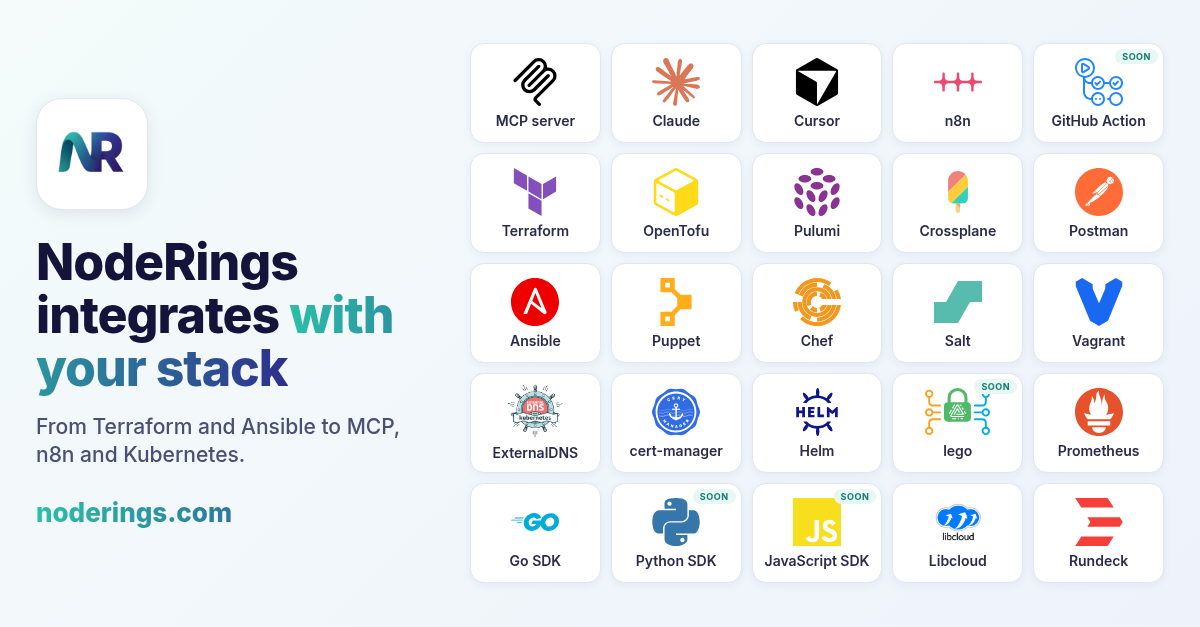
This post is the full list of what works today, what is still in review, and what we are building now.
AI agents: MCP, Claude and Cursor
NodeRings MCP server is a hosted Model Context Protocol server at https://mcp.noderings.com/mcp. It signs in with OAuth and calls the same API as the console, so an assistant can search the marketplace, create and power virtual machines, and manage DNS records. It is listed in the official MCP Registry as com.noderings/mcp.
Claude connects to that server as a remote MCP connector, so you can ask for a server in plain language and watch it appear in your account.
Cursor works the same way. Our walkthrough Create a VM from Cursor with NodeRings MCP goes from sign-in to SSH, and What Cursor can do over the NodeRings MCP is an honest list of what the assistant can and can't touch.
Infrastructure as code: Terraform, OpenTofu, Pulumi and Crossplane
Terraform and OpenTofu provider orders hourly VMs, firewalls, DNS and SSH keys as code, and stops the bill on destroy. It is published on both the Terraform and OpenTofu registries. Start with Order a VPS with Terraform and pay by the hour.
Pulumi provider gives you the same resources in TypeScript, Python, Go, C# and YAML, with packages on npm, PyPI, NuGet and pkg.go.dev. See How to use Pulumi on NodeRings to order a VPS.
Crossplane provider manages NodeRings virtual machines, DNS, firewall rulesets and access control as Kubernetes resources. It is built with Upjet and is available on the Upbound Marketplace. Read the Crossplane post.
Configuration management and developer tools
Ansible collection (noderings.cloud) has modules to order and manage VMs, DNS, firewalls and SSH keys, plus an inventory plugin. Every module supports check mode. See Order and configure a VPS with one Ansible playbook.
Puppet and OpenVox module adds types for VMs, DNS, firewalls and SSH keys, with a Bolt inventory plugin. Puppet walkthrough.
Chef cookbook, knife plugin and Test Kitchen driver: noderings-cookbook is on the Chef Supermarket, and knife-noderings and kitchen-noderings are on RubyGems. They work with Chef Infra and Cinc.
Salt extension is a Salt Cloud driver with execution and state modules. Salt walkthrough.
Vagrant provider runs vagrant up, ssh and destroy on NodeRings VMs, with no box needed. Vagrant walkthrough.
Rundeck plugin turns your VMs into Rundeck nodes and adds job steps to create, power and delete servers and manage DNS. Rundeck walkthrough.
Apache Libcloud drivers cover compute and DNS from Python. Libcloud walkthrough.
Automation and workflows: n8n
n8n community node (n8n-nodes-noderings) adds NodeRings to n8n for virtual machines, DNS, SSH keys, firewalls, snapshots and backups, plus a trigger that starts a workflow when a server appears, gets an IP or changes state. You can install it today from Settings → Community Nodes. We have also submitted it for n8n's manual review so it can be offered as a verified node. Read Automate NodeRings servers and DNS with n8n.
Kubernetes, DNS and certificates
ExternalDNS webhook provider keeps DNS records for your Kubernetes Ingresses and Services in NodeRings DNS. We have also opened a pull request to list it in the ExternalDNS docs, which is waiting on a maintainer's approval.
cert-manager DNS-01 webhook solves ACME challenges in NodeRings DNS, so Let's Encrypt and wildcard certificates work for zones hosted with us. It installs as a Helm chart from Artifact Hub. See Kubernetes DNS and TLS.
Prometheus service discovery gives Prometheus the list of your VMs and DNS host names, with region, plan, provider and tags as labels. In our test a new VM appeared in Prometheus 53 seconds after we created it. Read the post.
SDKs, CLI and API tools
Go SDK is the official Go client for the NodeRings API, at v0.1.0.
NodeRings CLI registers the provider agent that keeps a provider's hypervisor credential local. If you sell capacity on NodeRings, this is the tool you install.
Postman workspace has public Client API and Provider API collections, so you can try any endpoint before writing code. The API is also listed on RapidAPI.
Coming soon
These are in progress. We don't have dates for them yet.
- Python SDK: a first-party client for scripts, notebooks and data pipelines.
- JavaScript and TypeScript SDK: the same for Node.js and the browser.
- GitHub Action: create a server in a workflow, run your job on it, then delete it.
- lego DNS provider: ACME DNS-01 for NodeRings zones in lego, which other ACME tools build on.
Try it
Every integration above uses the same account and the same API, billed by the hour. Pick the tool you already know and order a server from it:
- Create an account at noderings.com.
- Add prepaid credit and an SSH key.
- Follow the walkthrough for your tool from the lists above.
If you'd like to see a tool we don't support yet, tell us at partners@noderings.com.