
Port 2049 is the NFS server. On Linux that server is nfsd, inside the kernel. NFS2ROOT CVE-2026-99362 is a heap overflow there, and it runs before any login. OpenSec, which gave the bug that name, says one TCP connection writes 61 bytes past a kernel heap object, and that they chained the write into a root shell. The kernel announcement introduces it in 3.16, commit 47ee52986472. OpenSec dates that commit to March 2014. BleepingComputer reports no exploitation in the wild, and credits the fix to ANSSI's Jérémy Jean.
The announcement's bug is in nfsd4_sequence(). The client can negotiate the cached reply down to the minimum, every slot then has a zero-length buffer, and the server still copies the reply into it. The KASAN line is a write of size 80. OpenSec reads that as 80 bytes copied, 61 past the heap object, 40 chosen by the client. heise says 61 bytes past the cache, 40 of them under the client's control. The oss-security note quotes the 61-byte summary.
cve.org and Ubuntu score it 9.8 (CVSS:3.1/AV:N/AC:L/PR:N/UI:N/S:U/C:H/I:H/A:H). Ubuntu's CVSS 4.0 score is also 9.8. Red Hat scores 9.4 with integrity Low, and describes a crash or potential code execution. OpenSec says the exploit stays private. SUSE matches the 9.8 on CVSS 3.1 and scores CVSS 4.0 at 9.0, with attack requirements present and privileges required low.
Who NFS2ROOT CVE-2026-99362 actually reaches
Four readings have to line up. nfsd is loaded. /proc/fs/nfsd/versions shows +4.1 or +4.2. TCP 2049 accepts a connection from the machine you are worried about. The running kernel is older than the fix on that line.
A host that only mounts a share is the client. Red Hat says a default install does not enable nfsd, and a deployment that is not an NFS server is outside this flaw. It reaches hosts that export: a file server, a homelab NAS, a build tree, a Proxmox node serving datasets.
SEQUENCE is an NFSv4.1 operation, and NFSv4.2 uses it too. OpenSec, heise, and Red Hat scope the exposed servers to those two versions. A server that speaks only NFSv3 is outside the operation the announcement describes.
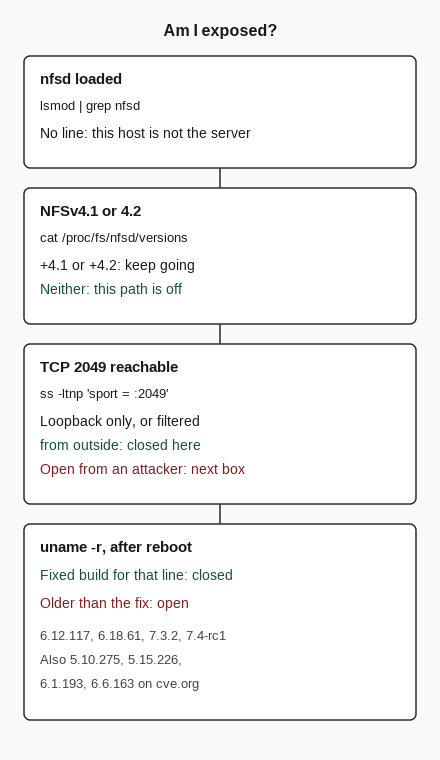
Check if the NFS server is exposed
On the host:
lsmod | grep nfsd
systemctl status nfs-server
ss -ltnp 'sport = :2049'
cat /proc/fs/nfsd/versions
uname -r
No nfsd line means the in-kernel server is not loaded, and /proc/fs/nfsd/versions will be missing. The unit is nfs-server (Debian ships it in nfs-kernel-server). A listener on 127.0.0.1 or ::1 only is not reachable from another machine. OpenSec reads +4.1 or +4.2 as on.
From another machine you control, aimed at your own host:
nmap -p 2049 <your-host>open means that machine completed a handshake to 2049. filtered means something dropped the probe. A provider firewall covers what ufw misses: the drop in front of the NIC is still there after ufw is flushed. A filtered probe from the internet can leave 2049 open on the private LAN, and that path is still this bug.
uname -r is the kernel that booted. The package on disk can be newer, which is the same trap as CVE-2026-98432, the Proxmox kernel to boot. A backport also keeps the old upstream number. Debian 12's fixed security kernel is still a 6.1 build.
The nfs2root patch, by kernel line
The fix refuses the slot unless the SEQUENCE result, plus room for a following error status, fits the negotiated cache. Mainline is 35ff1a7a7e38, in 7.4-rc1. BleepingComputer and OpenSec name 6.12.117, 6.18.61, 7.3.2, and 7.4-rc1. The cve.org record, which heise also lists, adds 5.10.275, 5.15.226, 6.1.193, and 6.6.163. Kernels before 3.16 are unaffected. A distro package can keep an older upstream number and still contain the commit.
| Line | Fixed at | Source |
|---|---|---|
| 5.10 through 6.6 | 5.10.275, 5.15.226, 6.1.193, 6.6.163 | cve.org |
| 6.12 through 7.4 | 6.12.117, 6.18.61, 7.3.2, 7.4-rc1 | announcement |
| Debian 12 security | linux 6.1.192-3 (plain 6.1.176-1 is vulnerable) | tracker, DLA-4942-1 |
Debian 12 linux-6.12 | 6.12.117-1~deb12u1 | tracker, DLA-4927-1 |
| Debian 13 | 6.12.117-1, security 6.12.118-1 | tracker |
| Ubuntu generic | no fixed package | Ubuntu |
| RHEL 8 | 4.18.0-553.190.1.el8_10 | RHSA-2026:103817 |
| RHEL 9 | Affected, no erratum | Red Hat JSON |
| RHEL 10.0 EUS | 6.12.0-55.121.1.el10_0 | RHSA-2026:104032 |
| RHEL 10.2 EUS | 6.12.0-211.78.1.el10_2 | RHSA-2026:104044 |
| AlmaLinux 8, Rocky 8 | 4.18.0-553.190.1.el8_10 | ALSA-2026:103817, RLSA-2026:103817 |
| SUSE kernels | Pending, no announcement | SUSE |
| Proxmox 7.0 | 7.0.14-30-pve imports stable through 7.3.3 and 6.18.62 | changelog |
| Proxmox 7.3 | 7.3.3-1-pve, sources are Linux 7.3.3 | Proxmox package changelog |
Install it, then reboot
On Debian, upgrade the image you boot, then reboot. Bookworm needs the security suite in its sources. Forky is 7.3.5-1, sid is 7.3.6-1, and the tracker marks unstable fixed at 7.3.3-1. A bookworm host on the separate linux-6.12 image has to upgrade that package too.
sudo apt update
sudo apt install --only-upgrade linux-image-amd64
sudo reboot
uname -r
Ubuntu marks generic linux vulnerable from 16.04 through 26.10. The 26.04 fix is work in progress in 7.0.0-45.45, and the 26.10 fix in 7.3.0-12.13. 14.04 is marked unaffected. Cloud HWE kernels are vulnerable too: linux-hwe-5.15 on 20.04, linux-hwe-6.8 on 22.04, linux-hwe-7.0 on 24.04. apt upgrade there has no fixed build yet.
RHSA-2026:103838 is kernel-rt at the same 4.18.0-553.190.1 version. RHEL 8.6 AUS and the 8.6 EUS long-life add-on are 4.18.0-372.230.1.el8_6 in RHSA-2026:104030. RHEL 6, RHEL 7, and RHEL 9 are Affected, and the base RHEL 10 product is absent from the fixed list. The erratum says to reboot.
sudo dnf upgrade kernel
sudo reboot
uname -r
Rocky also ships kernel-rt 4.18.0-553.190.1.rt7.531.el8_10 in RLSA-2026:103838. No AlmaLinux 9 or 10 erratum, and no Rocky 9 or 10 erratum, names this CVE.
SUSE's page says Pending: bugzilla still new, no security announcement, SUSE kernels listed under QA. SUSE Liberty Linux 8 tracks the RHEL 8 kernel. Their workaround is to block TCP 2049 or disable NFSv4. heise said the bug was not fixed across the board at Red Hat, Ubuntu, or SUSE. That still fits Ubuntu, SUSE's own kernels, and RHEL 9. RHEL 8 has an erratum.
When the distro has no fix yet
Stop the export when nothing needs it. Red Hat warns that this drops live sessions:
sudo systemctl stop nfs-server
sudo systemctl disable nfs-server
If the share has to stay up, OpenSec's stopgap in /etc/nfs.conf turns off the two versions that have SEQUENCE. Restart nfs-server afterward. OpenSec says this also turns off pNFS and some 4.2 features, so a client pinned to 4.2 will fail the mount until it asks for a version the server still offers.
[nfsd]
vers4.1=n
vers4.2=n
Or keep the daemon and drop TCP 2049 except the clients. On ufw the allow has to precede the deny:
sudo ufw allow from <storage-subnet> to any port 2049 proto tcp
sudo ufw deny 2049/tcp
On a NodeRings guest the stronger seat is the ruleset in front of the NIC. A flushed ufw does not reopen a port the hypervisor already dropped.
A KVM guest, including a marketplace Compute Instance, runs its own kernel, so the package and the reboot fix nfsd in that guest. A container that shares the host kernel cannot. NoisyTCP CVE-2026-99288 is the same split for a different bug.
Proxmox, and whether nfsd is even running
Most Proxmox nodes mount NFS, which makes them clients. The node is on the path when it exports, or when a privileged container does. A staff reply on a server-side copy thread (a hung NFSv4.2 copy, a different bug) says that in a privileged container the NFS server is the host kernel's nfsd. An NFS server inside a VM uses that VM's kernel.
The proxmox-kernel-7.0 changelog for 7.0.14-30 says the build takes Ubuntu-7.0.0-44.44 plus upstream stable changes through v7.3.3 and v6.18.62. cve.org marks 7.3.2 and 6.18.61 as the first fixed releases on those lines. The entry does not print CVE-2026-99362. The opt-in line does name its upstream: proxmox-kernel-7.3 7.3.3-1 updates sources to Linux 7.3.3, and the no-subscription repository also has 7.3.6-1. I did not find a forum.proxmox.com thread that names this CVE.
uname -r after the reboot should show 7.0.14-30-pve or newer, or 7.3.3-1-pve or newer. Empty the node first. Proxmox VE 9 for hosts is the release on this 7.0 line. A reply on the CVE-2026-99312 thread says 7.3 is not yet recommended for production. That remark is about the series.
Logs, then take 2049 off the public address
OpenSec says the packets are ordinary NFS, so there is no network signature. BleepingComputer quotes the same signs: a kernel warning from nfsd4_check_resp_size (on attempts that succeed and on attempts that fail), a shell spawned by a kernel worker, a burst of short NFSv4.1 sessions from one address, and an oops with nfsd4_*, svc_*, or call_usermodehelper* frames.
sec=sys trusts the uid a client claims, and this overflow is earlier than that check. Put the share on a network only the clients can route to. WireGuard on Ubuntu 24.04 is one way, with 2049 bound to the tunnel address and a drop for everyone else on the provider firewall. Until uname -r is a row from the table, the kernel answering 2049 is the old one.
FAQ
Does NFS2ROOT affect NFS clients?
The bug is in the kernel NFS server, in fs/nfsd/nfs4state.c. A host that only mounts shares is the client. Red Hat's statement says a deployment that does not operate as an NFS server is outside this flaw.
Is NFSv3 affected by CVE-2026-99362?
The kernel announcement puts the bug in SEQUENCE, an NFSv4.1 operation. OpenSec, heise, and Red Hat scope the exposed servers to NFSv4.1 or NFSv4.2. Turning 4.1 and 4.2 off is the stopgap both heise and OpenSec give.
Do I need to reboot after the nfs2root patch?
Yes. The code runs in the kernel that is already loaded. Red Hat's erratum says the system must be rebooted. uname -r after the boot is the version answering packets.
Is a Proxmox node that only uses NFS storage exposed?
Mounting NFS storage makes the node a client. The node is exposed when its own nfsd serves NFSv4.1 or 4.2 on a reachable TCP 2049, including a privileged container whose NFS server is the host kernel.
What if Ubuntu has no nfs2root package yet?
Ubuntu's tracker marks the generic kernels on 16.04 through 26.10 vulnerable, with the 26.04 and 26.10 fixes still in progress. Until a package exists, stop nfs-server or limit TCP 2049 to the clients that mount the share.