
nginx -V on a stock Ubuntu web VPS prints --with-http_v2_module, and the HTTPS block still has http2 on the listen line. That pair is the precondition for nginx CVE-2026-123007. F5's description, as Ubuntu's tracker quotes it, says the HTTP/2 flow-control window can exceed its threshold, the result is a heap buffer overflow, and the worker usually segmentation-faults. Code execution is possible when ASLR is off, or when the attacker can bypass it.
nginx shipped the fix on 18 November 2026 in 1.30.7 (stable) and 1.31.9 (mainline). AlmaLinux's notice, citing F5, scores this CVE and the four that shipped with it at 8.1 on CVSS v3.1 and 9.2 on CVSS v4.0. Ubuntu's CVE-2026-123007 page confirms both scores. A distro package can still print nginx/1.24.0 after the fix is installed. The package revision is what changed.
Which listener nginx CVE-2026-123007 needs
nginx.org's advisory list marks CVE-2026-123007 vulnerable from 1.9.5 through 1.31.8, and fixed from 1.30.7 and 1.31.9 up. 1.9.5 is the release that added HTTP/2. CERT-EU advisory 2026-022 calls it an integer overflow in HTTP/2 flow control that writes out of bounds on the heap, and says the only precondition is HTTP/2 on a listening port. Static files are enough. Wiz reported code execution, including an ASLR bypass, against official builds serving static files over HTTPS with no backend.
The same tarballs fix four more worker bugs. F5's write-up for the flow-control bug is K000163926. CERT-EU groups the five as the set that can run code as the worker. 1.30.8 and 1.31.10, dated 23 November 2026, add a separate ssl_early_data CPU fix, CVE-2026-132779. Take those if the repo has them. 1.30.7 is the first stable with the five.
| CVE | What has to be on | Upstream range | Fixed in |
|---|---|---|---|
| CVE-2026-123007 | HTTP/2 on a listener | 1.9.5-1.31.8 | 1.30.7, 1.31.9 |
| CVE-2026-123633 | HTTP/2, and the worker runs out of connections while talking upstream | 1.19.7-1.31.8 | 1.30.7, 1.31.9 |
| CVE-2026-121810 | A quic listener (HTTP/3) plus an upstream | 1.25.0-1.31.8 | 1.30.7, 1.31.9 |
| CVE-2026-123634 | resolver, proxy_pass built from the request, mirror with mirror_request_body off | 0.6.18-1.31.8 | 1.30.7, 1.31.9 |
| CVE-2026-113425 | Mail proxy with auth_http | 0.5.33-1.31.8 | 1.30.7, 1.31.9 |
All five are 8.1 on CVSS v3.1 and 9.2 on CVSS v4.0 in that AlmaLinux reading of F5. Code runs as the user directive account, www-data or nginx on distro packages.
CVE-2026-123633 is the other HTTP/2 bug. The changelog ties it to worker_connections running out. CERT-EU describes connection draining closing a live HTTP/2 connection while nginx is still connecting upstream. CVE-2026-121810 is that shape on QUIC, from 1.25.0, so 1.24 is outside it. CVE-2026-123634 needs the resolver and a second lookup from a subrequest. Xint says SSI can reach it as well as mirror. CVE-2026-113425 is the mail proxy. No mail { } block and no mail module means that one is closed.
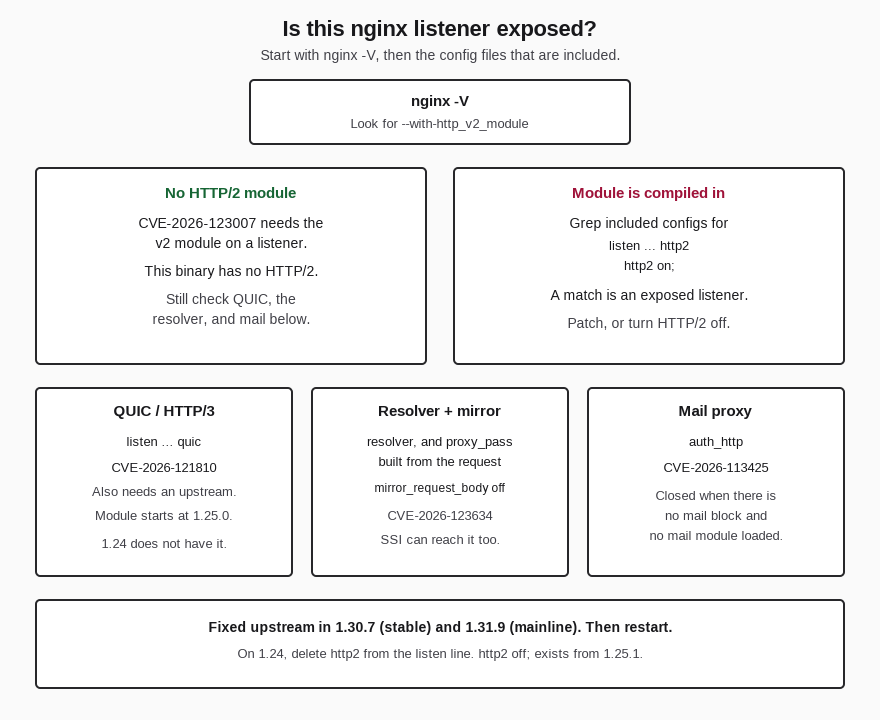
Read nginx -v, then the package
nginx -v prints the upstream version. nginx -V adds the configure arguments, on stderr. Look for --with-http_v2_module and, for QUIC, --with-http_v3_module.
The version string is the wrong field on a distro package. Ubuntu 24.04's fixed build is still nginx 1.24.0. The LEMP lab on that release installed 1.24.0-2ubuntu7.19 before this advisory. USN-9159-1 moves it to 1.24.0-2ubuntu7.20. nginx -v prints nginx/1.24.0 on both.
nginx -v
nginx -V 2>&1 | tr ' ' '\n' | grep with-http
dpkg -l nginx
rpm -q nginx and apk info nginx are the rpm and Alpine equivalents. NGINX Plus is a separate product. NVD's CPE ranges list fixes before 37.0.8.1 and 37.3.0.1, and list R34, R35, and R36 as affected. Containers, panel builds, and a second binary on port 8443 are covered in NGINX2Root on a VPS.
The directive depends on the version
http2 on; and http2 off; arrived in nginx 1.25.1. The v2 module docs default the directive to off, in http and server context. From that version, listen 443 ssl http2; still works, and nginx -t warns that the parameter is deprecated.
Ubuntu 24.04, Ubuntu 22.04, and Debian 12 are older than 1.25.1. They have the http2 parameter on listen and they do not have the http2 directive. http2 off; makes nginx -t fail on those builds. Delete the parameter:
# 1.24 and older. This listener is exposed.
listen 443 ssl http2;

# Mitigation on that build.
listen 443 ssl;
On 1.25.1 and later (Debian 13's 1.26, Ubuntu 26.04's 1.28, nginx.org packages, current Docker images):
listen 443 ssl;
http2 on;

# Mitigation.
http2 off;
AlmaLinux notes the socket gotcha on the old syntax. If any server on an address and port still has http2 on its listen line, HTTP/2 stays on for every site on that socket. Grep sites-enabled, conf.d, and anything a panel writes under /etc/nginx:
sudo grep -RnE '^\s*(listen\s.*\bhttp2\b|http2\s+on)' /etc/nginxA clean grep means HTTP/2 is off, so CVE-2026-123007 cannot be reached there. gRPC clients need HTTP/2, so this mitigation drops them. Browsers fall back to HTTP/1.1. After a restart, AlmaLinux's check should print 1.1:
curl -so /dev/null --http2 -w '%{http_version}\n' https://www.example.com/HTTP/3 is a different socket. The v3 module dates from 1.25.0 and the example is listen 443 quic reuseport beside a TLS listen. http3 defaults to on when the module is compiled, and traffic arrives only on the quic listener. Remove that listen, or set http3 off;, then restart. Turning HTTP/2 off leaves QUIC up.
WordPress on Nginx and MariaDB is where the parameter usually lands, in a copied HTTPS block or from Certbot. FastCGI cache does not change the listener. Nginx FastCGI cache versus LiteSpeed cache measured a 1.24.0 binary. OpenLiteSpeed in that comparison is a different program.
Update nginx 1.30.7, or take the backport
Ubuntu and Debian backport onto the old upstream number. The nginx.org packages publish the upstream number and pin origin nginx.org at priority 900, so they beat the distro. apt-cache policy nginx shows which origin wins. An nginx.org origin needs 1.30.7 or later (stable) or 1.31.9 or later (mainline), then a restart. The table below is the distro origin.
| Distro | Fixed package |
|---|---|
| Ubuntu 26.10 | 1.30.4-7ubuntu1.2 |
| Ubuntu 26.04 | 1.28.3-2ubuntu1.13 |
| Ubuntu 24.04 | 1.24.0-2ubuntu7.20 |
| Ubuntu 22.04 | 1.18.0-6ubuntu14.23 |
| Ubuntu 20.04, 18.04, 16.04 | The ESM builds in the same USN, via Ubuntu Pro |
| Debian 12 security | 1.22.1-9+deb12u11 (DLA-4918-1) |
| Debian 13 security | 1.26.3-3+deb13u11 (DSA-6642-1) |
| Debian forky and sid | 1.30.6-4 and later, still numbered 1.30.6 |
Those Ubuntu rows are USN-9159-1. The Debian rows are the security tracker. Ubuntu 14.04's nginx 1.4.6 has no HTTP/2, and the CVE page marks it unaffected for this bug. The USN still ships a 14.04 package for older issues in the same notice. Debian marks the pre-security bookworm and trixie revisions vulnerable. If apt-cache policy never offers the security revision, the security suite is missing from the sources.
sudo apt update
sudo apt install --only-upgrade nginx
apt-cache policy nginx
sudo systemctl restart nginx
--only-upgrade skips a box that has no nginx package. USN-9159-1 sets nginx, nginx-core, nginx-full, nginx-light, and nginx-extras to the same revision. Upgrade whichever of those dpkg -l shows as installed.
AlmaLinux, Rocky, Alpine
AlmaLinux's 18 November post lists these builds and says Red Hat had not shipped that day. A newer rpm -q nginx from the same repo still counts. On AlmaLinux 8 the default stream is retired nginx:1.14, with no build for this fix. The patched stream is nginx:1.24. dnf module list nginx shows which one is enabled.
| System | Package at or above |
|---|---|
| AlmaLinux 8, stream 1.24 | 1.24.0-3.module_el8.10.0+4373+4291aaad.6.alma.4 |
| AlmaLinux 9, default 1.20 | 1.20.1-32.el9_9.1.alma.4 |
| AlmaLinux 9, stream 1.24 | 1.24.0-9.module_el9.9.0+356+d723c317.1.alma.4 |
| AlmaLinux 9, stream 1.26 | 1.26.3-10.module_el9.9.0+357+ccfac862.1.alma.2 |
| AlmaLinux 10 | 1.26.3-16.el10_3.1.alma.3 |
| AlmaLinux Kitten 10 | 1.26.3-17.el10.alma.2 |
| Rocky Linux 8, module 1.24 | 1:1.24.0-3.module+el8.10.0+40469+da1f451a.9 (RLSA-2026:100747) |
| Rocky Linux 9 | 2:1.20.1-32.el9_9.2.rocky.0.1 (RLSA-2026:100748) |
| Rocky Linux 10 | 2:1.26.3-16.el10_3.3 (RLSA-2026:100744) |
The Rocky errata are dated 21 November 2026 and name Red Hat RHSA-2026:100747, RHSA-2026:100748, and RHSA-2026:100744. On RHEL, install the build that RHSA offers for your minor release.
dnf module list nginx
sudo dnf upgrade 'nginx*'
rpm -q nginx
sudo systemctl restart nginx
Alpine's tracker lists 1.26.3-r4 on 3.21, 1.28.3-r8 on 3.22 and 3.23, and 1.30.7-r0 on 3.24 and edge. apk update && apk upgrade nginx, then restart the process. Many Alpine images have no systemd, so replace the container if nothing else supervises nginx.
On a marketplace Compute Instance this package is in the guest. NoisyTCP CVE-2026-99288 is the kernel case, and a container guest waits on the host. This bug is the nginx binary. Restart nginx. Reboot only when a kernel package is what you are loading.
Docker tags, then a new container
On Docker Hub the supported tags currently point stable and 1.30 at 1.30.8, and mainline, latest, and 1.31 at 1.31.10. Both include the 18 November fixes. A pin to nginx:1.30.7 or nginx:1.31.9 is already on the fixed line. A pin to nginx:1.27, nginx:1.28, or nginx:1.31.8 is not.
Pulling a tag leaves the running container on the old image, so recreate it. A FROM nginx:1.27 image needs a rebuild and a redeploy.
docker exec "$name" nginx -v
docker pull nginx:1.30.8
docker compose up -d --force-recreate --pull always
docker exec "$name" nginx -v
Panels and ingress-nginx
Plesk ships two nginxes. The Plesk article says Obsidian 18.0.82 Update 4 and 18.0.81 Update 9 move website nginx (sw-nginx) and the panel server (sw-cp-server on port 8443) to 1.30.7. Until that update is installed, Plesk's mitigation is plesk bin http2_pref --disable and plesk bin http3_pref --disable for sites, and http2 off; in /etc/sw-cp-server/conf.d/plesk.conf for the panel.
CloudPanel and aaPanel often run a nginx the distro package manager does not own. apt upgrade can look current while the panel binary is the one on 443. Use the panel updater, then nginx -v on the binary in that service file.
Nginx Proxy Manager in the Caddy, Traefik, and NPM lab reported OpenResty 1.31.1.1, and the generated server block had http2 off. OpenResty numbers follow the nginx they build on, so 1.31.1.1 is the 1.31.1 line, inside the vulnerable 1.31 range. HTTP/2 was off in that config. Turning it on later needs an OpenResty build that contains the fix.
Community ingress-nginx is the Kubernetes project. F5's migration note says it stopped at v1.15.1 on 19 March 2026, with no further release, so that repository is not going to publish a 1.30.7 image. F5's NGINX Ingress Controller is a separate version line. Broadcom's note, for a product that embeds the community controller, shows the temporary switch as use-http2: "false" on the controller ConfigMap. That closes the two HTTP/2 bugs on that controller. Check the image tag you run.
The error log, then a real restart
CERT-EU says to watch for worker process … exited on signal in the error log. They call the line a sign of an attempt, and a poor indicator of code execution. A bad module, a full disk, or the OOM killer produce the same phrase. Repeated lines while nobody is changing config are a reason to patch and to keep the log. Process-creation logs are what show a shell.
sudo grep "exited on signal" /var/log/nginx/error.logA segmentation fault is signal 11, which is what the changelog describes. Other signals use the same phrase.
systemctl reload nginx and nginx -s reload send HUP. The control page says HUP starts workers with the new config and asks the old workers to finish. The master stays. After a package upgrade, that master is still the previous binary.
systemctl restart nginx replaces it. To keep the listen sockets open, the same page's sequence is USR2 (new master from the binary now on disk), WINCH (old master shuts its workers down gracefully), QUIT (old master exits). Distro packages use /run/nginx.pid. After USR2 the old pid is in nginx.pid.oldbin.
sudo nginx -t && sudo systemctl restart nginx
readlink "/proc/$(cat /run/nginx.pid)/exe"
nginx -v
pgrep -a nginx
If readlink ends in (deleted), the process is still mapped to the file the package replaced. Restart again. One master should remain. The signal form, when you need it:
sudo kill -USR2 "$(cat /run/nginx.pid)"
sudo kill -WINCH "$(cat /run/nginx.pid.oldbin)"
sudo kill -QUIT "$(cat /run/nginx.pid.oldbin)"
Send USR2, WINCH, and QUIT to the old master. When .oldbin is gone, one master remains. On a backport, nginx -v still prints 1.24.0. The dpkg or rpm revision is what shows the new file is the fixed one.
CERT-EU said researchers had demonstrated CVE-2026-123007 and reported no in-the-wild exploitation in that advisory. Rapid7 wrote that the strategy they published moves about 128 GB of HTTP/2 data, and that a path slower than about 300 Mbit/s runs into nginx's default one-hour connection lifetime. They know of no other code-execution strategy yet. A public HTTP/2 listener on a small VPS still wants the new binary.
FAQ
Is nginx 1.24 affected by CVE-2026-123007?
An unpatched 1.24 with HTTP/2 on a listener is inside 1.9.5-1.31.8. The HTTP/3 bug starts at 1.25.0. Ubuntu 24.04's fix stays on 1.24.0 at revision 1.24.0-2ubuntu7.20, so nginx -v looks the same before and after. On that build, delete http2 from listen. nginx -t rejects http2 off; there, because that directive is from 1.25.1.
Does disabling HTTP/2 fix the November 2026 nginx bugs?
It closes CVE-2026-123007 and CVE-2026-123633. That is CERT-EU's mitigation when you cannot update yet. QUIC, the resolver-and-mirror setup, and the mail proxy stay reachable when those configs are on. Turn HTTP/2 back on after readlink on the master pid shows the new binary.
Do I need to restart nginx, or is a reload enough?
Restart, or run the USR2 upgrade above. A reload keeps the old master, and that master keeps running the file you just replaced on disk. This patch does not need a VPS reboot. Reboot when you are loading a kernel.
Is CVE-2026-123007 being exploited?
CERT-EU's 18 November advisory reported a demonstration and no in-the-wild exploitation at publication. Wiz reported lab code execution on a static-file HTTPS server, with an ASLR bypass. exited on signal records a crash. CERT-EU treats it as a weak sign of an attempt, and says it does not show that code ran.
I use the nginx.org apt repo. Do I install the Ubuntu revision?
Install the nginx.org package. Priority 900 keeps apt off 1.24.0-2ubuntu7.20. The candidate should be 1.30.7 or later on stable (1.30.8 in the 23 November changelog) or 1.31.9 or later on mainline (1.31.10). Restart after it installs. The Ubuntu table is the distro origin.