
CVE-2026-123158, nicknamed SSHole, is a password authentication bypass in OpenSSH on musl systems. On Alpine Linux built the way almost everyone runs it, an attacker who knows the name of a key-only account can send a password of 257 to 1024 characters and get a shell without any password at all. It is already on CISA's Known Exploited Vulnerabilities list, and the fix is OpenSSH 10.6p2, released on November 5, 2026. If you run an Alpine VPS, an Alpine-based container with sshd inside, or Alpine LXC guests on Proxmox, this is the one to check first.
This is the SSH version of the problem we keep coming back to on this blog: the service is doing exactly what it was told, and the default configuration is the hole. If you have read 12,000 SSH attempts, counted properly, you already know most SSH noise is brute force that never lands. SSHole is different. It is not a guess that eventually wins. It is one connection, every time, and no password to guess.
What SSHole actually does
When OpenSSH is built without PAM, it checks a password itself. It runs your attempt through crypt() and compares the result to the password field stored for the account. For an account that should never accept a password, that stored field is a single *. A * is not a valid hash, so under normal conditions nothing you type can ever match it. That is the whole point of a *: a locked, key-only account.
Two older decisions collide here. Back in 2016, OpenSSH added a timing fix (CVE-2016-6210): when there is no real hash to check, sshd borrows another account's salt and hashes your password anyway, so a wrong login for a * account takes the same time as a wrong login for a real one. Separately, musl's crypt() refuses passwords longer than 256 bytes and signals that failure by returning the string *. That is the same * the locked account stores.
So on musl without PAM: you target a * account, sshd borrows a real account's $6$ salt, hands your 300-character password to crypt(), and musl returns *. sshd compares * to the stored *, they match, and you are in.
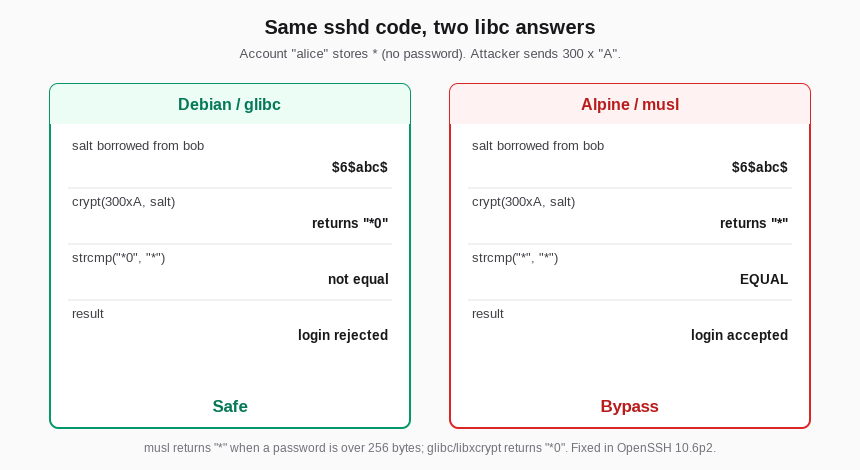
I confirmed the libc half of this on a current Alpine 3.24 image (musl 1.2.6). With salt $6$abc$, a 300-byte password comes back as exactly *, while a normal password returns a full $6$ hash. On Debian's glibc the same overlong input returns *0, which never equals a stored *. That one extra character is the entire difference between affected and safe. NVD describes the window as any password between 256 and 1024 characters; OpenSSH caps password length at 1024 bytes, which is why the range stops there.
NVD rates it CVSS 3.1 8.1 (High), with the "High" attack complexity reflecting that the attacker needs a valid account name and the box has to be in the vulnerable state. The requirement is narrow, but on a default Alpine host it is often met by accident.
Am I affected?
All of these have to be true at once. If any one is false, you are safe.
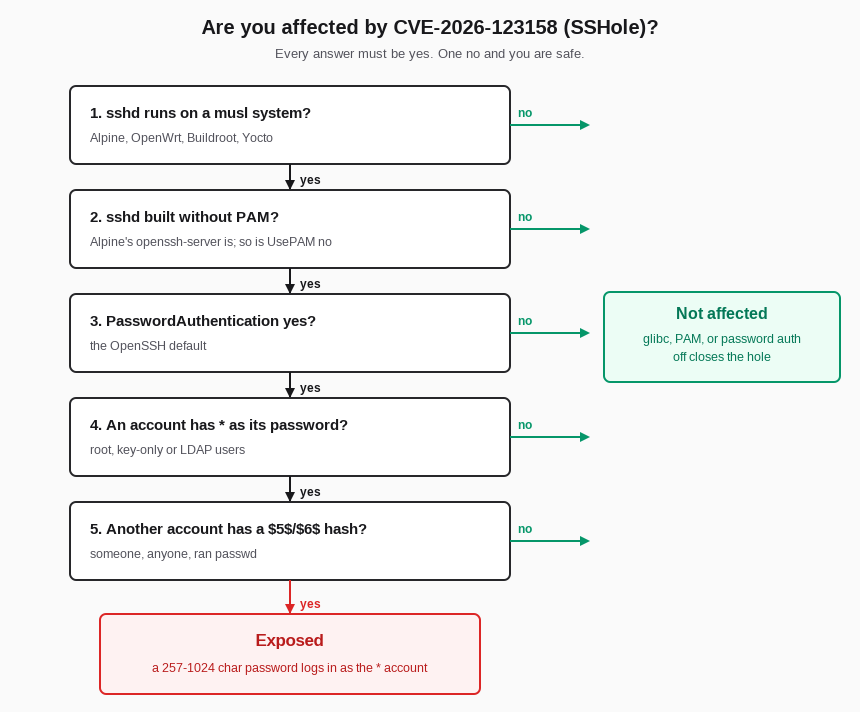
| Condition | Affected when | Notes |
|---|---|---|
| C library | musl | Alpine, OpenWrt, Buildroot, Yocto. glibc is safe. |
| PAM | not built in | Alpine's openssh-server package, or openssh-server-pam with UsePAM no. UsePAM yes is safe. |
| Password auth | PasswordAuthentication yes | the OpenSSH default. |
A * account | at least one | key-only users, LDAP users via musl-nscd, root (ships as root:*). |
| A hashed account | at least one $5$/$6$ | created the moment anyone runs passwd. |
A fresh box with no passwords set anywhere is not exploitable: the attack needs at least one real hash on the system to borrow a salt from. The trap is that the first time an admin sets a console password, every * account on the machine becomes reachable.
Note that PermitRootLogin defaults to prohibit-password, so root itself is usually not directly reachable. The danger is a non-root * account that can log in and then escalate, which brings us to the images people actually run.
Check your own system
Three commands tell you where you stand. First, the libc and whether PAM is compiled in:
ldd /usr/sbin/sshd 2>/dev/null | grep -q musl && echo "musl" || echo "not musl"
/usr/sbin/sshd -V 2>&1   # look at how it was built
apk info -e openssh-server-pam && echo "pam package present"
Then the effective password setting (this reads the real running config, Match blocks included):
sshd -T | grep -i '^passwordauthentication'Then look for * accounts that can still log in:
awk -F: '$2=="*"{print $1}' /etc/shadowIf sshd is musl without PAM, passwordauthentication yes, and that last command prints any name, you are exposed. The researcher also published a check.sh at github.com/oz9un/sshole that reports exactly which condition you are missing.
The three places this bites on a VPS
1. A plain Alpine VPS
This is the headline case. Alpine's standard openssh-server is built without PAM, password auth is on by default, and root ships as root:*. The ones that hurt are cloud images: Alpine's official tiny-cloud images (the qcow2, VHD, and AMI artifacts) from 3.18.11 through 3.24.3 ship an alpine user with a * password and passwordless doas. That account is effectively root. It is safe on first boot, but the moment any $6$ hash exists on the box, an attacker can log in as alpine and doas straight to root. Images built from 3.21.10, 3.22.8, 3.23.8, 3.24.4 and later carry the fixed package.
2. Alpine-based containers running sshd
Most containers never run sshd, and those are fine. But plenty of appliance images, CI runners, and "pet" dev containers are Alpine with an SSH daemon bolted on. If that image installs openssh-server, turns on password auth, and has a * account plus any hashed account, it is exposed exactly like a VPS. If you deploy containers with Docker Compose on a VPS, grep your images for sshd and rebuild from a base that has the patched package, rather than patching the running container.
3. Alpine LXC guests on Proxmox
If you run Proxmox, the split matters. The Proxmox host itself is not affected. Proxmox VE 9 is built on Debian 13, its sshd is the Debian package, and that package links glibc and ships UsePAM yes by default. I verified both on a current Debian openssh-server: it links libpam and libcrypt (glibc's, which returns *0), and its shipped sshd_config sets UsePAM yes. So the node you manage the cluster from is in the clear, the same way it was for the Proxmox kernel in CVE-2026-98432. (If you are still standing up nodes, installing Proxmox VE 9 walks through that base.)
The exposure is inside Alpine LXC guests. A guest you built from an Alpine template, installed openssh in, and left on password auth is vulnerable just like a standalone Alpine box. One reassuring detail: Proxmox's current Alpine LXC template (alpine-3.24-default_20261105) already ships the fixed openssh and does not even install sshd out of the box, so a freshly created guest from today's template is not running a vulnerable daemon until you add one. Older cached templates and any guest where you enabled SSH password login are the ones to check. The same care applies to Debian or Ubuntu templates you build with cloud-init on Proxmox, though those use glibc and are not affected by this particular bug.
How to patch
On Alpine, update and then restart the daemon. Upgrading the package does not restart a running sshd, so the second line is not optional:
apk upgrade -U -a
rc-service sshd restart
Alpine shipped fixed packages for every supported branch on November 5, the day of disclosure, and backported the fix to older releases down to 3.16. Because the fix was backported, the package version number often does not change, so a scanner that only compares versions may still flag a patched box. Check against this table instead:
| Alpine branch | Fixed openssh version |
|---|---|
| edge | 10.6_p2-r0 |
| 3.24 | 10.3_p1-r2 |
| 3.23 | 10.2_p1-r1 |
| 3.22 | 10.0_p1-r11 |
| 3.21 | 9.9_p2-r1 |
| 3.20 | 9.7_p1-r6 |
| 3.19 | 9.6_p1-r3 |
| 3.18 | 9.3_p2-r4 |
For a custom build or any other musl system, you need OpenSSH 10.6p2, or you can apply the upstream fix (commit 4353fdc43) on top of an older release. The fix is small: sshd now refuses to treat a stored field shorter than four characters as a hash, so a bare * can never match again.
If you can't patch right now
Turn password authentication off. This closes SSHole completely, and if you run key-only anyway you lose nothing:
echo 'PasswordAuthentication no' > /etc/ssh/sshd_config.d/00-no-passwords.conf
sshd -t && rc-service sshd restart
sshd -T | grep -i passwordauthentication   # expect: passwordauthentication no
Alpine reads the sshd_config.d directory from release 3.19 onward; on older releases edit /etc/ssh/sshd_config directly. Before you restart, confirm your key login already works and keep your current session open until you have tested a new one. Locking the * accounts by switching their field to ! also works, because ! is handled differently from *, but disabling password auth is the cleaner single step.
Were you already hit?
Because exploitation needs no retries, there is no failed-login trail. Look instead for successes that should be impossible. In /var/log/messages, an Accepted password for line for an account that has no password (alpine, root, or any key-only user) is the signature:
grep 'Accepted password' /var/log/messagesCross-check each name against your * accounts. Then review recent doas use, new users, new files, and new entries in any authorized_keys. If you cannot rule out a login on an internet-facing box, treat it as compromised and rebuild rather than clean.
Harden so the next one is boring
Patching closes this bug. The posture that makes the next SSH bug a non-event is the same one that has always worked: key-only auth, a firewall in front of the guest, and something watching the door. Turning off password auth entirely is the biggest single win here and would have neutralized SSHole on day zero. A rate limiter like the ones compared in fail2ban vs CrowdSec does not stop a one-shot bypass, but it keeps the brute-force noise off your logs so the real events stand out. And a firewall outside the guest limits who can reach port 22 at all; on a NodeRings Compute Instance that is the panel firewall, which drops packets before they ever reach sshd, the same way it helped against the kernel race in NoisyTCP.
FAQ
My server runs Ubuntu or Debian. Am I affected by CVE-2026-123158?
No. SSHole only works on musl systems with PAM disabled, which in practice means Alpine and a few other musl distros. Ubuntu, Debian, AlmaLinux, and Rocky use glibc and PAM, so their sshd never hits the bug. If you run Alpine-based containers with sshd inside those hosts, check the containers.
Does disabling password authentication fix it?
Yes, completely. The bug is in the password check, so if sshd never does a password check there is nothing to bypass. Setting PasswordAuthentication no is the recommended stopgap until you can update, and a fine permanent setting if you use keys.
A scanner still flags my server after I updated. Why?
Alpine backported the fix without changing the package version number on the stable branches, so a scanner comparing version strings sees an "old" openssh. Confirm against the fixed-version table above, or run the sshd -T and /etc/shadow checks, rather than trusting a version-only scan.
Is SSHole being exploited?
CISA added CVE-2026-123158 to its Known Exploited Vulnerabilities catalog on November 9, 2026, which is the bar for confirmed in-the-wild use, and set a short remediation deadline for federal agencies. Treat any reachable, unpatched Alpine host with password auth as a live target.
Do I need to reboot?
No. Restarting the sshd service is enough (rc-service sshd restart). Upgrading the package alone does not swap out the already-running daemon, so the restart is the step that actually applies the fix.