
Terra Security pointed a forged page table at about 127 GB of a DigitalOcean host's RAM, from inside a droplet, mapped read-only, and found the host's kernel version banner there. The bug is CVE-2026-99312. It is in KVM, on AMD CPUs, and it needs nested virtualization enabled. It sat in the kernel for just under four years. The patch that opened it was the fix for CVE-2022-3344, which switched a reset back to the outer VM's control block and left the nested page table pointer where it was. Terra's PatchSlop count had found that 3.2% of kernel CVEs were introduced by the fix for another CVE.
KVM keeps one guest's memory away from the next guest on the same server. On a host this bug reaches, a guest that can run a VM of its own can name host physical pages, including pages that belong to other guests. Terra showed the write on a server they owned: the guest put chosen bytes into a host kernel page, and a witness module they had loaded reported the change. The Hacker News account says both tests started with root inside a VM the researchers controlled.
What the KVM guest to host escape is doing
The guest sees its own memory starting at address zero. KVM translates that through a nested page table in host memory, and Terra's write-up calls the field that names the top of the table the NPT pointer. The guest stays in its own RAM while that pointer names a page KVM still owns. Nested virtualization runs a VM inside the guest. While the inner VM runs, the processor uses the inner pointer, and an INIT with paging already off skips the update that points the outer VM back at its own table. The outer VM keeps a pointer to a page the kernel has freed. The kernel announcement calls that a stale MMU context, because the page role includes guest mode.
The freed page comes back as a bottom-level table of the guest's own pages, while the processor still reads it as the top level. One of the guest's ordinary pages becomes the next level, the guest writes that page, and the processor walks the host physical pages those entries name. On the droplet that was about 127 GB, read-only. On Terra's own server one entry was a writable host kernel page. INIT is an unconditional intercept on VMX, so KVM never emulates INIT while an inner guest is running on Intel. The same note limits the bug to nested SVM.
Who the AMD nested virtualization vulnerability reaches
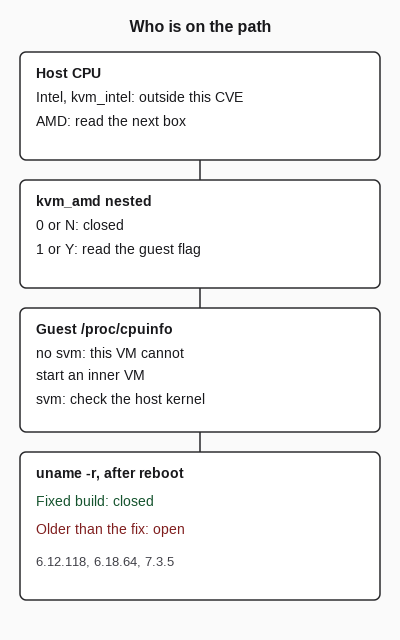
Red Hat's statement requires nested virtualization on an AMD KVM host. Intel KVM is outside it, and so is an AMD host whose kvm_amd nested parameter is off. Terra surveyed providers and found many in that second group.
The guest still has to be able to start the inner VM. Proxmox keeps that separate from the module: the nested virtualization wiki says VMs do not get hardware-assisted virtualization extensions by default, and they receive them when the CPU type is host with nested support enabled on the physical host. A reply on the forum thread puts the exposure on that guest setting. A fixed package on disk waits for a reboot.
The svm flag inside the guest
From inside the VPS:
grep -m1 '^flags' /proc/cpuinfo | grep -o -w svm
lscpu
The Proxmox wiki uses egrep '(vmx|svm)' /proc/cpuinfo once the nested guest OS is installed. svm is AMD-V. vmx is Intel VT-x, and the kernel announcement puts that platform outside this bug. lscpu prints the AMD flag as Virtualization: AMD-V when svm is in the flags. /proc/cpuinfo is the file to grep when util-linux is missing.
svm means this VM was given AMD-V, so it can load kvm_amd and start the inner guest the INIT path needs. The host kernel version is a separate reading. A guest with no svm was not given AMD-V. On Proxmox that is the default CPU type, and that VM cannot start a nested KVM guest. The model name on the same lscpu is which chip the guest was sold, which what 4 vCPU means on EPYC 9004 vs Xeon E5 covers. An EPYC guest with no svm was not handed AMD-V. NoisyTCP CVE-2026-99288 is the case where guest and host share a kernel. Here the vulnerable code is the host's KVM, so an update inside a marketplace Compute Instance replaces the guest only.
What the host reads for kvm_amd nested
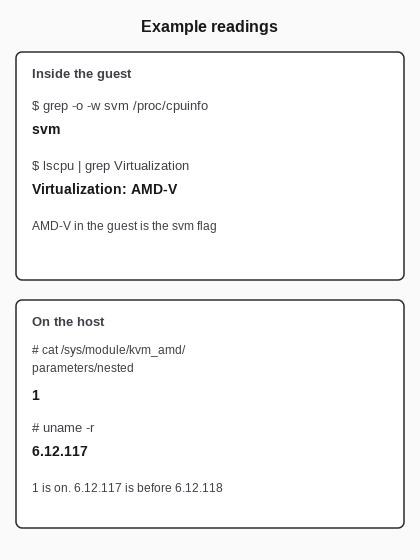
On the host, as root:
cat /sys/module/kvm_amd/parameters/nested
uname -r
Red Hat documents the first command, and the mitigation that sets the parameter to 0. If that path is missing, the AMD module is not loaded.
1 or Y means the module will virtualize SVM. 0 or N means it will not. The kernel's nested-guest page shows Y for the Intel parameter, and says that from v4.20 the parameter is enabled by default for Intel and AMD unless the distribution overrides it. Proxmox's wiki shows N when Intel nested is off, and the AMD line that turns it on is options kvm-amd nested=1. Read the character that is in the file.
Then compare uname -r with a build that contains the fix. The announcement lists 6.12.118, 6.18.64, 7.3.5, and 7.4-rc2. OSV adds the later long-term backports, 5.15.226, 6.1.193, and 6.6.163. The introducing commits landed in 6.1, and the same change was carried into 5.15.81 and 6.0.11.
Distribution package versions do not follow those upstream numbers. Debian's tracker and Ubuntu's page are below. Ubuntu scores the bug 8.8, CVSS:3.1/AV:L/AC:L/PR:L/UI:N/S:C/C:H/I:H/A:H, the vector cve.org publishes. Red Hat's record is a draft 7.8 with attack complexity High, severity Important. Until that record names a fixed build, dnf update on RHEL 9 or 10 has nothing new to install for this CVE.
| System | Tracker status |
|---|---|
| Debian 13 (trixie) security | Fixed at 6.12.118-1, DSA-6652-1 |
| Debian 12 (bookworm) | Vulnerable at 6.1.176-1 and security 6.1.192-3. No fixed bookworm version in the tracker |
| Debian forky and sid | Fixed at 7.3.5-1 and 7.3.6-1 |
Ubuntu 22.04, 24.04, 26.04 linux | Vulnerable |
Ubuntu 26.10 linux | Vulnerable, work in progress in 7.3.0-12.13 |
Ubuntu 20.04 generic linux | Not affected. linux-hwe-5.15 on 20.04 is vulnerable |
| Ubuntu HWE on 22.04 and 24.04 | linux-hwe-6.8 and linux-hwe-7.0 are vulnerable |
RHEL 8 kernel | Not affected |
RHEL 9 and 10 kernel | Affected, no fixed release in the record |
RHEL 9 kernel-rt | Not affected |
The Proxmox kernel, the reboot, and nested=0
The forum thread is where the Proxmox builds got numbers. One reply says the fix is in the enterprise repository from 7.0.14-30-pve, and links commit 440212e. That commit adds 0119-KVM-x86-Unconditionally-reset-MMU-context-when-emula.patch, the upstream subject. The 7.0.14-30 changelog describes the same work as a nested-virtualization fix, also with SMM, and the entry does not print the CVE id. Another reply says 7.3.5 is in the no-subscription repository, that 7.3 is still opt-in, and that it is not yet recommended for production. uname -r after the reboot is the check, the same habit as CVE-2026-98432: the Proxmox kernel to boot. The package can be installed while the previous kernel is still what boots, and a cluster still has to empty the node first.
If the node cannot take that window yet, Red Hat's mitigation shuts the VMs down, then reloads the module:
modprobe -r kvm_amd
modprobe kvm_amd nested=0
echo "options kvm_amd nested=0" > /etc/modprobe.d/kvm-nested-disable.conf
The options file is what the next boot reads. The module stays loaded while a VM is running, which is why Red Hat says to shut the guests down first. Proxmox's wiki spells the options name kvm-amd, with a hyphen, and the sysfs path kvm_amd, with an underscore. Edit the file you already have under /etc/modprobe.d/ if one is there.
nested=0 closes this path and every hypervisor inside a guest. The kernel's nested-guest page names the ordinary uses: testing another OS, image tools that start a VM, and OSes that use virtualization for isolation. Proxmox VE 9 for hosts describes the nested-virt flag as the switch for Windows Virtualization-based Security. On AMD that flag is how the guest receives svm, so those guests lose hardware nested virt at nested=0. The forum reply says Docker does not use nesting, and a chroot does not either. The wiki also says a VM with the vmx or svm flag cannot be live-migrated.
What to ask your provider
A rented VPS cannot read /sys/module/kvm_amd/parameters/nested. That file is on the host. From inside, svm or its absence is what you can collect. The ticket asks whether the node is AMD, what the nested file prints, whether the VM CPU type is host or carries nested-virt, what uname -r prints, and whether that build is 7.0.14-30-pve or newer, 7.3.5 or newer on the opt-in kernel, or one of the upstream versions above. Ask if the node has rebooted since the package was installed.
The Hacker News report says the provider in Terra's test patched its fleet with a live patch and told Droplet customers that no action was needed on their side. A small Proxmox host does not have that live patch in a status mail. Asking for uname -r and the nested setting is the same habit as the five checks before you prepay a new host: a number the sales page leaves out. Red Hat's description of the flaw is read and write access to host memory. No package inside the guest closes it.
FAQ
Does the svm flag mean my VPS is vulnerable to CVE-2026-99312?
svm means the guest was given AMD-V, so it can start a nested VM. The host is on the path when that flag is present, the CPU is AMD, kvm_amd nested is on, and the running host kernel is older than the fix. A guest with no svm cannot start that nested guest.
Are Intel KVM hosts affected by CVE-2026-99312?
The kernel announcement says the bug only affects nested SVM, because INIT is an unconditional intercept on VMX. Red Hat's statement says Intel-based KVM deployments are not affected. A vmx flag in the guest is the Intel extension.
Does Docker need kvm_amd nested?
A reply on the Proxmox forum says Docker does not use nesting, and a chroot does not either. Containers keep working with the parameter at 0. A guest that runs its own hypervisor, including nested Proxmox or Windows VBS on the nested-virt flag, loses that hardware path.
Which kernel fixes CVE-2026-99312?
Upstream fixes are in 6.12.118, 6.18.64, 7.3.5, and 7.4-rc2. OSV also lists 5.15.226, 6.1.193, and 6.6.163. Debian 13 is fixed at 6.12.118-1. The Proxmox forum names 7.0.14-30-pve on the default kernel and 7.3.5 on the opt-in kernel. Ubuntu's page marks the generic kernels on 22.04 through 26.10 vulnerable, and Red Hat lists RHEL 9 and 10 as Affected with no fixed release in its record. The host has to boot the new kernel.
Does updating the guest kernel fix CVE-2026-99312?
The vulnerable code runs in the host's KVM. A guest package upgrade replaces the kernel inside the VM. uname -r inside the guest can look current while the host is still on the old module. The host administrator installs the host kernel and reboots the node.