
Enzonix
Shared Compute - General Compute
$5.00/mo
1 vCPU · 1 GB · 20 GB
Choose location
Ashburn, United States
| Provider | Plan | vCPU | RAM | Disk | Regions | Billing | Price |
|---|---|---|---|---|---|---|---|
| Enzonix | Shared Compute - General Compute | 1 | 1 GB | 20 GB | Ashburn, United States | Fixed price | $5.00/mo |
| Enzonix | Shared Compute - General Compute | 1 | 1 GB | 20 GB | Amsterdam, Netherlands | Fixed price | $5.00/mo |
| Enzonix | Shared Compute - General Compute | 2 | 4 GB | 80 GB | Amsterdam, Netherlands | Fixed price | $9.00/mo |
| Enzonix | Shared Compute - General Compute | 2 | 4 GB | 80 GB | Ashburn, United States | Fixed price | $9.00/mo |
| Enzonix | Shared Compute - General Compute | 4 | 8 GB | 160 GB | Amsterdam, Netherlands | Fixed price | $16.00/mo |
| Enzonix | Shared Compute - General Compute | 4 | 8 GB | 160 GB | Ashburn, United States | Fixed price | $16.00/mo |
| Enzonix | Shared Compute - General Compute | 8 | 16 GB | 320 GB | Amsterdam, Netherlands | Fixed price | $32.00/mo |
| Enzonix | Shared Compute - General Compute | 8 | 16 GB | 320 GB | Ashburn, United States | Fixed price | $32.00/mo |
| Enzonix | Shared Compute - General Compute | 1 | 1 GB | 20 GB | Ashburn, United States | Hourly | $0.007/hr |
| Enzonix | Shared Compute - General Compute | 1 | 2 GB | 40 GB | Ashburn, United States | Hourly | $0.01/hr |
| Enzonix | Shared Compute - General Compute | 2 | 4 GB | 80 GB | Ashburn, United States | Hourly | $0.015/hr |
Xboard Instant App
Xboard is the shop panel. User tunnels come from a node backend: Xboard-Node on this VPS when the installer can start it, or V2bX or soga. Compare live prices, deploy, and hand out subscription links.

Xboard
Instant App on marketplace VPS
Live marketplace offers
Choose billing and size, compare providers side by side, pick a location, then launch.
Shared Compute - General Compute
$5.00/mo
1 vCPU · 1 GB · 20 GB
Choose location
Ashburn, United States
1 provider
Xboard is a V2Board-style subscription panel (Laravel, with SQLite and Redis in this Instant App). The panel stores users, plans, and nodes. It does not carry user traffic by itself. This install prefers a colocated Xboard-Node and also works with V2bX or soga. The admin email is noderings@${IPV4}.sslip.io and the password comes from the installer output. Use it instead of paying for a managed proxy-panel host.
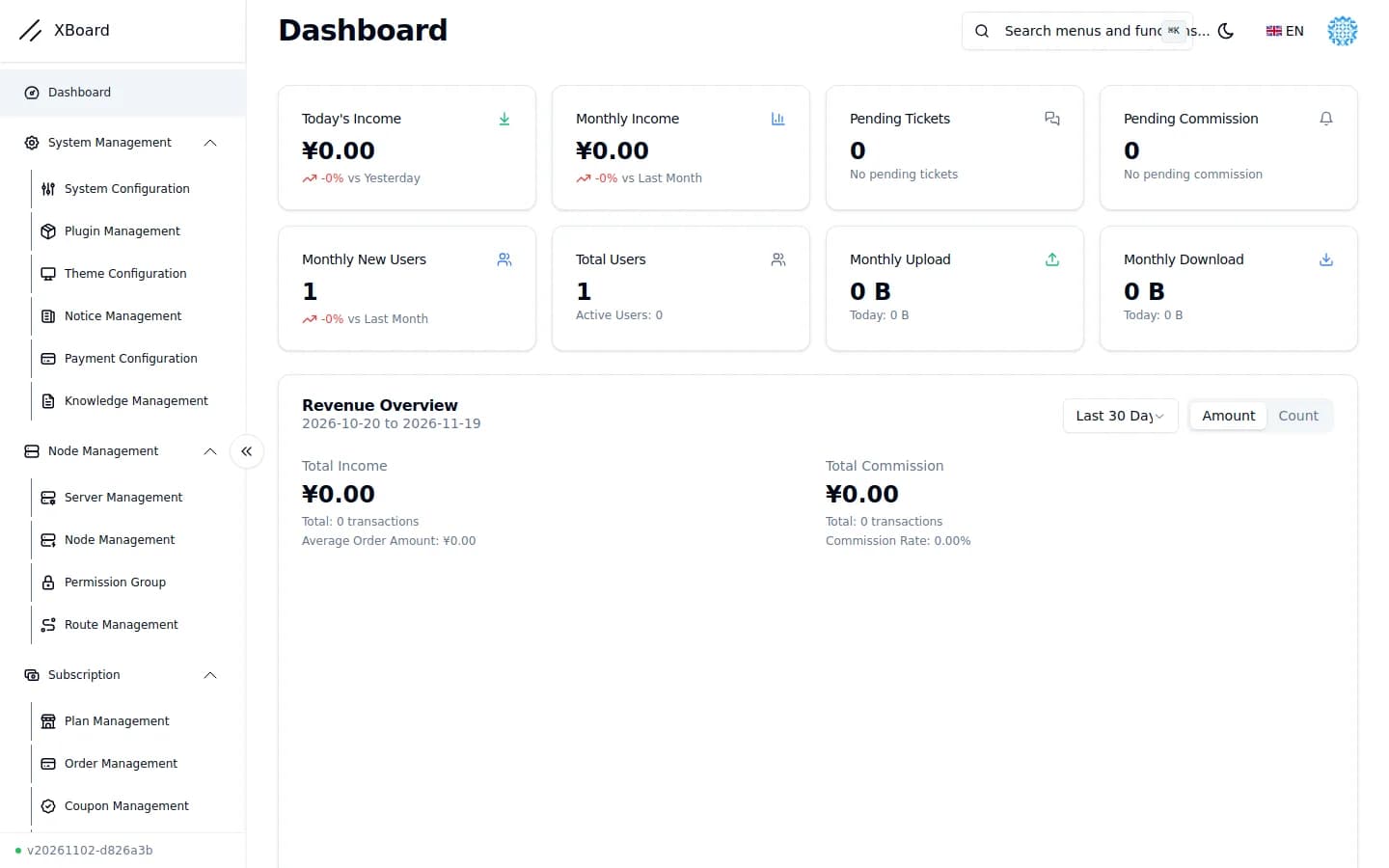
Open the secure admin path on port 7001. Sign in with the Instant App email/password, then change the password.
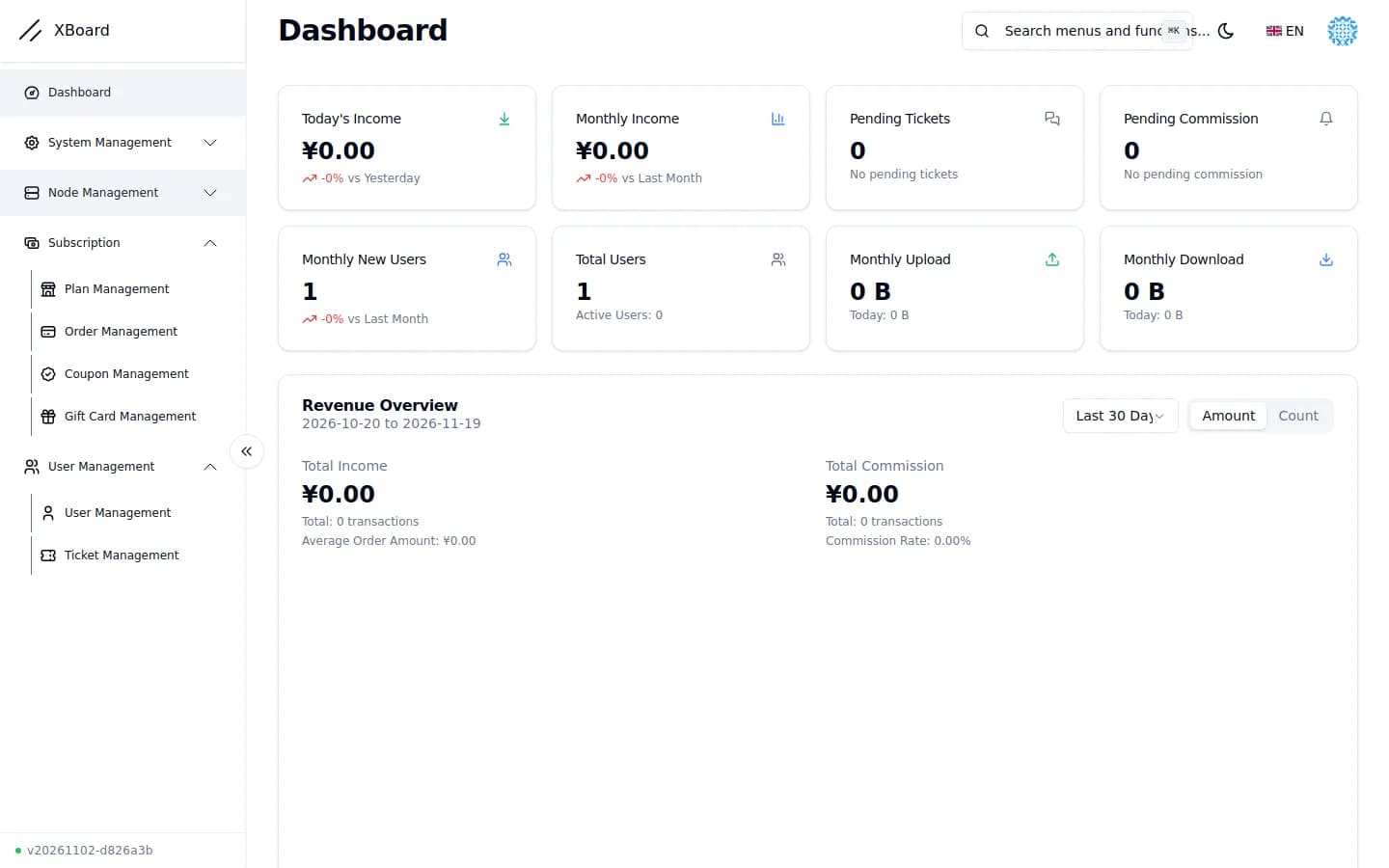
Register Xboard-Node (preferred) or pair V2bX / soga. First boot can start a colocated xboard-node container when an API key exists.
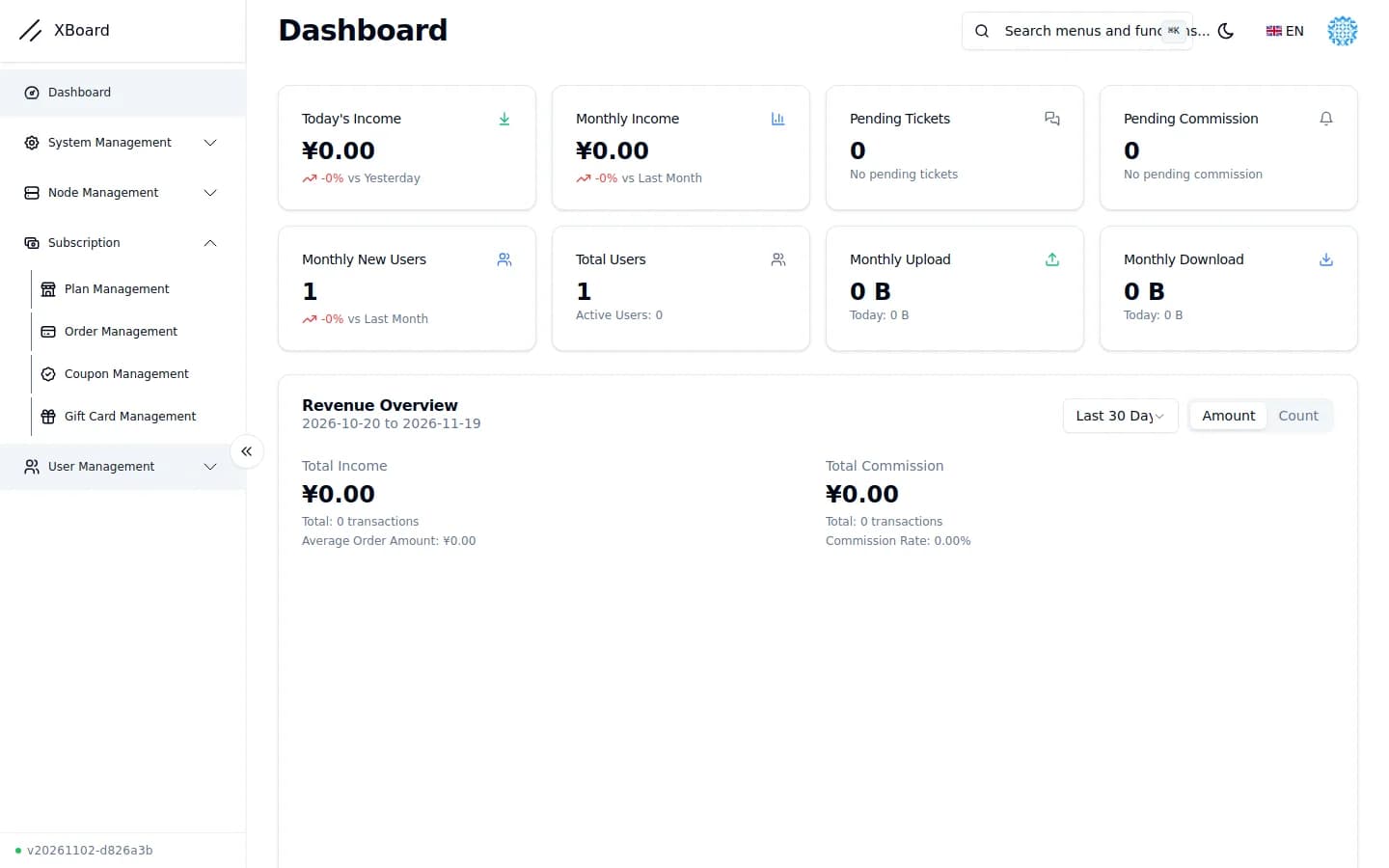
Create users and subscription links in the admin UI. Phones import the link for the protocols you enabled on the node.
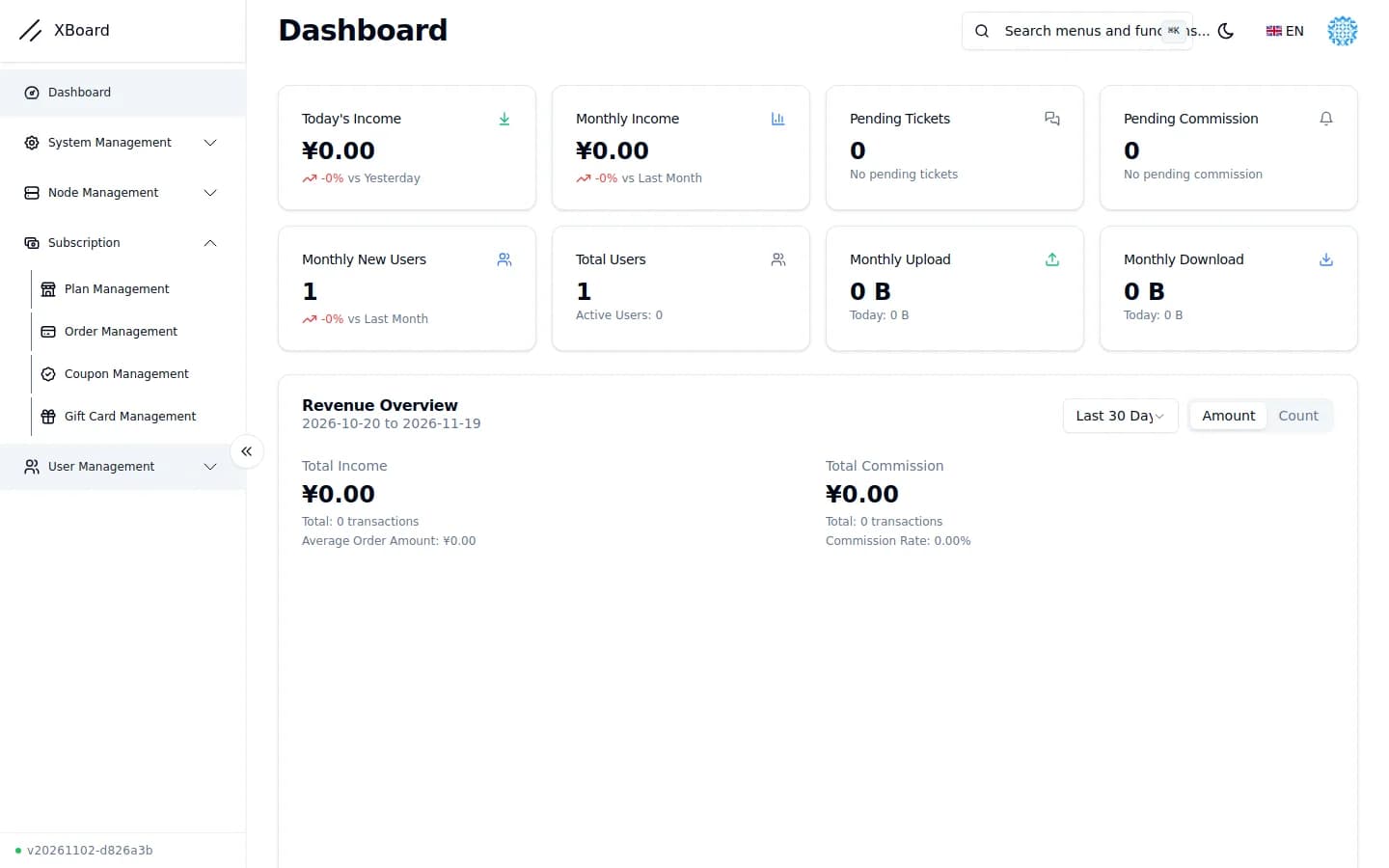
Theme, payments, notices, and secure path live under System Management — not in a password-file screenshot.
Xboard panel + a node backend (Xray-class)
Xboard is the shop and the admin UI. The tunnel is whatever the node runs. This Instant App prefers Xboard-Node on the same VPS (container xboard-node, node id 1, API on 127.0.0.1:7001). V2bX and soga can replace that worker. A panel login with no node and no imported subscription leaves the phone on its normal connection.
After the VPS is up, sign in, change the admin password, and confirm a node backend is actually running.
01
In a browser, open http://YOUR_IP:7001/ . Port 80 is only a short status page that points at the credentials file.
02
SSH in as root. The email is noderings@ followed by the VPS IPv4 and .sslip.io. The password is whatever the Xboard installer printed.
cat /root/.noderings_password03
Use xboard_admin_email and xboard_admin_pass. Change the password before you leave the panel on the public internet.
04
xboard_node_started=1 means container xboard-node was started with nodeID 1. In the admin UI, create the node record that id expects and enable the protocol you want clients to use. If the flag is 0, the API key was missing and you still need a node.
05
TCP 22 is SSH. TCP 7001 is the panel. TCP 80 is the status page. The proxy port is the one you set on the node (Xboard-Node, V2bX, or soga). That port is not open until the node has an inbound.
Users live in the Xboard admin UI. A user without a node protocol has a subscription that does not connect.
01
Add a node whose id matches the worker. The colocated container uses node id 1. Point other backends (V2bX or soga) at this panel with the API key from the Xboard env file.
02
In the admin UI, add a user and attach the plan or quota you want. The first admin account is the operator login, not a VPN client.
03
Open that user and copy the subscription URL or QR. The format follows the node protocol (VLESS, VMess, Trojan, Shadowsocks, or a Clash profile, depending on what you enabled).
04
Importing one link on a phone and a laptop counts as one user unless you set a device limit in the panel.
05
Disable or delete the user in the admin UI, then refresh the client. Old subscriptions should stop after the node picks up the change.
Import the user's subscription after a node is online. The panel password does not connect the phone.
01
Android: v2rayNG, NekoBox, or Hiddify. iOS: Hiddify, Streisand, Happ, or Shadowrocket. Windows: v2rayN, Happ, or Hiddify. Clash Meta when the subscription is Clash-compatible.
02
Paste the user subscription URL. If the node is not running, the import can succeed and the tunnel can still fail.
03
Select the profile and turn the tunnel on. Allow the VPN permission the phone asks for.
04
Open a page that shows your public IP and compare it with the node address you configured.
05
Confirm xboard_node_started, the node record, and the proxy port. A panel on port 7001 with no node has nothing for the phone to join. Reality-style links also fail when the phone clock is wrong.
These apps run on the phone or computer. They are not Instant Apps. They import the subscription your node publishes. Which link works depends on the protocol you enabled.

Android. Import the user subscription.

Android client built on sing-box.

Imports subscription links from the user account.

iOS, and macOS on Apple silicon.

Phone and desktop builds.

Paid iOS app. Imports subscription links.

Windows. Paste the subscription URL.

Use when the panel gives you a Clash-compatible subscription.
Xboard is a panel people use to run a small subscription service. The exit only exists after a node backend is up. A filtered network still depends on the protocol that node serves.
| Situation | Fit | What to expect |
|---|---|---|
| Multi-user subscriptions | Often used | The panel is built for plans, users, and subscription links. That is the job, once a node is attached. |
| Everyday privacy exit | Depends on the network | Useful after the node is passing traffic through the VPS you picked. The panel alone is an admin site. |
| China (GFW) | Depends on the network | Xboard-class panels are commonly used for subscription shops. Whether a line connects depends on the node protocol, SNI, and that ISP. No unblock guarantee. |
| Filtered networks in Iran | Depends on the network | Possible when the node serves something that network still allows, often Reality. Test on your own line. |
| Panel with no node | Poor match | Subscriptions do not create a tunnel until Xboard-Node, V2bX, or soga is online and matched to a node record. |
Compare live Xboard VPS plans from independent providers, then run the subscription panel with an optional colocated Xboard-Node on the offer you pick. Use it instead of paying for a managed proxy-panel host.
See live prices, regions, and plan sizes before you buy. Shop self-hosted subscription panels across independent providers.
Deploy Xboard and the VPS comes up with the panel on port 7001, an admin email on sslip.io, and a password taken from the installer. It also tries to start Xboard-Node on the same machine.
The provider region is the geography of the VPS address. Client links use whatever hostname and protocol you set on the node.
The installer password is written on the server. Change it after the first sign-in. You decide which users receive a subscription.
Most Xboard guides assume one server you already own. NodeRings lists Compute Instance plans from independent providers so you can compare self-hosted panel offers by price, size, and region, then launch on the one that fits.
Xboard Instant App prepares the panel on the provider VPS you selected and tries to place Xboard-Node beside it. The provider operates that machine. NodeRings lists the plan and deploys the Instant App. NodeRings does not run the proxy.
Compare plans, pick a provider offer, and launch Xboard on that server.
01
Pick a provider offer. A sensible start is 2 vCPU, 2 GB RAM, and 30 GB disk. Smaller and larger plans stay on the list.
02
Launch the Instant App on that plan. The panel install runs on first boot and records the admin password. There are no extra form fields.
03
Confirm a node backend is online, create a user, and import that subscription in v2rayNG, Hiddify, Clash Meta, or another app below.
NodeRings Instant App installs the Xboard image, runs the upstream installer with SQLite and Redis, saves the admin password from that output, and tries to start Xboard-Node on the same host.
Credentials are written on first boot to:
/root/.noderings_passwordRead them over SSH:
cat /root/.noderings_passwordXboard Compose project
/opt/noderings/xboardCompose file, .env, plugins, and storage.
Panel env and admin notes
/opt/noderings/xboard/.env
/opt/noderings/xboard/admin.env
API key lives in the panel env. The admin email is recorded beside it.
Credentials file
/root/.noderings_passwordWritten on first boot. Includes the installer password.
Install log
/tmp/xboard-admin.logBootstrap output, including the installer stdout.
Compose runs the Xboard image (SQLite and Redis inside that container) and a status page. Xboard-Node is a separate container on the host network when the API key was found.
xboardPanel on port 7001.
statusnginx status page on port 80.
xboard-nodeOptional colocated node (host network, node id 1). Not a Compose service.
Panel Compose
cd /opt/noderings/xboard && docker compose psColocated node
docker ps --filter name=xboard-nodeThe Xboard admin starts on http://YOUR_IP:7001. Cloudflare's orange cloud publishes 80 and 443. It does not, by itself, publish port 7001. Put a reverse proxy on 443 that forwards to 127.0.0.1:7001, then point a domain at the VPS.
Add your domain
Sign up at Cloudflare and add the domain you want on the panel.
Proxy the panel onto 443
On the VPS, forward public 443 to the panel on 127.0.0.1:7001. Leave the node proxy ports as the node requires them.
Point the domain at your VPS
Create an A record to your server IP and leave the orange cloud on. Open https://your-domain and set the panel URL to that https address.
Only allow Cloudflare to 80 and 443
Optional, after the reverse proxy exists. Keep port 22 allowed. This rule does not cover 7001 or the node protocol port.
curl -s https://www.cloudflare.com/ips-v4 | while read ip; do sudo ufw allow from "$ip" to any port 80,443 proto tcp; doneIf the reverse proxy is the only public door to the panel, close 7001 on the public interface. Keep the node protocol port reachable by clients.
The panel, Redis, and a colocated node share one VPS. These rows are starting points, not a filter on the plans above.
| Workload | Illustrative starting point | Note |
|---|---|---|
| Panel plus a few users | 2 vCPU, 2 GB RAM, 30 GB disk | Matches the Instant App floor. |
| A small subscription group | 2 vCPU, 4 GB RAM, 40 GB disk | More headroom when the node and the panel are busy together. |
| Many users on one box | 4 vCPU, 4-8 GB RAM, 40 GB disk | Move the node to another host when this VPS is only the panel. |
Illustrative only. Live plans are not filtered by this table. A filtered network can still block a tunnel that fits on a small VPS.
You get root on a provider VPS. NodeRings lists the plan and deploys Xboard. The provider runs the machine.
The admin password, which node backend is attached, who receives a subscription, the host firewall, and the provider terms.
The VPS, the network, and the exit IP. Abuse on a public proxy port can get that provider to suspend the server.
The marketplace and the Instant App. NodeRings does not run a VPN service and does not see client traffic.
v2rayNG and NekoBox on Android. Hiddify on Android, iOS, Windows, macOS, and Linux. Streisand on iOS and macOS. Happ on phone and desktop. Shadowrocket on iOS. v2rayN on Windows. Clash Meta when the subscription is Clash-compatible. The link only works after a node backend is serving that protocol.
People use Xboard-class panels for subscription shops, and the node protocol is what the ISP sees. Reality and similar choices are commonly tested. A panel with no node does not connect. Test on your own line. No unblock guarantee.
The panel includes users and nodes. Traffic is carried by Xboard-Node (this Instant App tries to start it), or by V2bX or soga. Check xboard_node_started in the credentials file.
Import the same user subscription on the second device, or create another user when you want a separate quota. Disable the user in the admin UI to stop a device.
3X-UI and v2ray-agent run Xray on the same VPS without a shop. Xboard is the shop. It needs a node backend before anyone has a tunnel.
TCP 22 for SSH, TCP 7001 for the panel, and TCP 80 for the status page. Also leave open the protocol port you configure on Xboard-Node, V2bX, or soga.
NodeRings lists provider plans and deploys the Instant App onto the plan you pick. The provider operates the VPS. You operate Xboard and its node.
SSPanel UIM Instant App
Another shop panel. Pair it with soga, XrayR, or Air-Universe. This install does not include the node.
v2ray-agent Instant App
Docker Reality with Xray and a ready VLESS URL. No shop panel.
MTProto Proxy Instant App
Telegram-only proxy on port 443. Not a general VPN.
reality-ezpz Instant App
One-command VLESS Reality installer without a browser admin.
3X-UI Instant App
All-in-one Xray panel when you do not need a subscription shop.
Outline Server Instant App
Jigsaw Outline Shadowsocks server with access keys.
Hiddify Manager Instant App
All-in-one panel with Xray and sing-box on the same VPS.
All Instant Apps
Browse every Instant App landing on Compute Instance.