
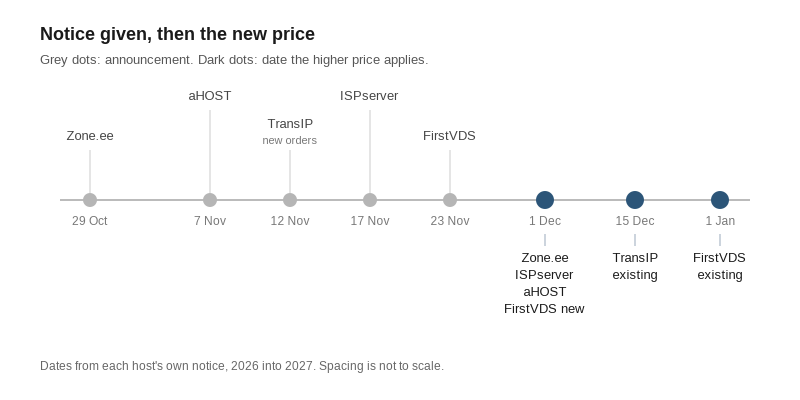
Five VPS hosts have put a VPS price increase on the calendar for the next five weeks, and four of them start on the same morning, 1 December 2026. ISPserver in Moscow is raising every virtual server by about 50%. FirstVDS says 30% on average, with its smallest new plan up 40%. aHOST in Tashkent adds 30% to its current line and 40% to its old one. TransIP moves existing BladeVPS customers to the new list on 15 December. Zone.ee in Estonia, and its Finnish sister brand SpeedZone, add roughly 10% to 15%.
Every one of those notices names the same cause: memory and drives. This post puts the five announcements side by side, with the old price, the new price, the date the new price reaches a server you already rent, and the one question that matters this week. Can you still pay the old price for a while?
I read each host's own notice for every number below. Where a host published only an average, the table says so.
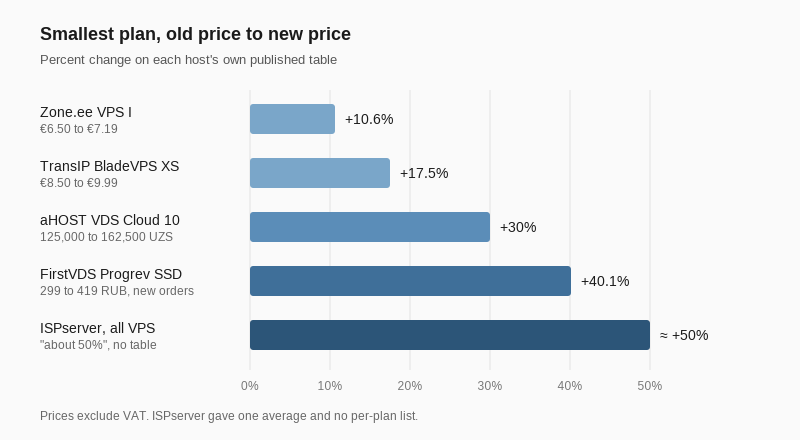
The December 2026 VPS price increases in one table
| Host | Plan, old → new (per month, excl. VAT) | Change | New orders | Servers you already rent | Notice |
|---|---|---|---|---|---|
| ISPserver (Russia) | All VPS plans, including archived ones | about +50% | 1 Dec 2026 | 1 Dec 2026, recalculated automatically | 17 Nov 2026 |
| FirstVDS (Russia, NL, KZ) | Progrev SSD 299 → 419 RUB. Start SSD 519 → 729 RUB | +30% on average | 1 Dec 2026 | 1 Jan 2027, +30% on ready plans | 23 Nov 2026 |
| aHOST (Uzbekistan) | VDS Cloud 10: 125,000 → 162,500 UZS | +30%, archive plans +40% | 1 Dec 2026 | At the first renewal from 1 Dec | 7 Nov 2026 |
| TransIP (NL, BE) | BladeVPS XS €8.50 → €9.99. X2 €15.99 → €19.99 | +6% to +25% | 12 Nov 2026 | 15 Dec 2026, first 2027 invoice | Price list |
| Zone.ee (Estonia) and SpeedZone (Finland) | VPS I €6.50 → €7.19. VPS II €9.12 → €10.49 | +9% to +15% | 1 Dec 2026 | Not stated separately | 29 Oct 2026 |
Two things jump out once the rows sit together. The percentages are spread wide, from single digits to half again. And the dates for customers who already have a server are not the same as the dates for new orders. If you rent at TransIP or FirstVDS, you have a few more weeks at the old number than a new customer does. At ISPserver you don't.
Why VPS prices are going up now
Every notice points at hardware, and they mean the same two parts.
FirstVDS was the most specific. Its notice says server memory costs about 2.5 times what it did in January 2026 and drives about 3.4 times. Between January and October it spent more than 2.5 times as much on equipment as in the same months of 2025, and delivery takes months, so it buys ahead. It adds a second cost that has nothing to do with chips: from January 2027, rack space in Moscow costs it 50% more, where the usual yearly rise is about 8%.
aHOST said that, measured against its own purchases over the last couple of years, server RAM and SSDs have become up to ten times more expensive. TransIP's explanation page, updated 12 November, puts the blame on AI. Memory makers are moving production toward the specialised memory that AI systems use, which leaves less for ordinary server memory. Zone.ee's one sentence of explanation names "memory and storage devices" and the cost of upgrading its servers.
The market data agrees with the hosts. TrendForce's 4Q26 forecast, published 30 September, expected conventional DRAM contract prices to rise another 10% to 15% quarter over quarter, and NAND flash 15% to 20%. It also said server DRAM would stay undersupplied through the quarter, and that enterprise SSDs were the only memory category where the rise was speeding up rather than slowing. Server memory and enterprise SSDs are exactly what a VPS host fills its nodes with.
Here is why that lands on a small VPS harder than on a big cloud bill. On a typical node, RAM is usually the part that runs out first. A host sells memory and the CPU mostly comes along for the ride. When the price of a gigabyte of RAM more than doubles, the cost of every plan goes up with it, and the cheapest plans have the least margin to soak it up. What one Proxmox node has to earn per sold gigabyte walks through that arithmetic. Change the hardware line in it and the break-even price per gigabyte moves with it.
This isn't the first round this year either. Hetzner raised new cloud orders on 15 June 2026, and its CCX13 went from €15.99 to €42.99. That one, and the licence increases from cPanel and WHMCS, are in the hosting price-change log. FirstVDS itself raised VDS prices on 1 July. The December round is a second turn of the same screw.
Host by host: what changes and what you can still do
ISPserver: about 50%, and no way to prepay around it
ISPserver's notice of 17 November is short and blunt. From 1 December every server plan goes up: virtual servers by about 50%, including archived plans, and dedicated servers bought before 20 July 2026 by 20%. New and existing customers both pay the new price.
The increase covers hardware and compute only. Microsoft licences, ispmanager, DDoS-protected channels and the 1 Gbit/s ports keep their prices. Backups, object storage and extra IPs change: object storage becomes 3 RUB per GB, an additional IP 225 RUB, and old backup prices on archived plans are multiplied by 1.25. Existing discounts keep working, but they apply to the new price.
The notice has a section titled "Can I keep the old price?" For dedicated servers, yes: pay for any period by 30 November and the old price holds for that whole period. For virtual servers, the answer is no. The new price is recalculated automatically from 1 December. If you rent a VPS there, the choice is to accept it, shrink the plan, or move.
FirstVDS: 30% on average, January for current servers
FirstVDS split its increase into two dates. New orders pay the new list from 1 December 2026. Servers already running move on 1 January 2027.
For new orders, the minimum configuration of each ready plan goes up between 25% and 41%. The cheapest SSD plan, Progrev, goes from 299 to 419 RUB a month. Start goes from 519 to 729. On flexible plans, the add-on prices move by resource: CPU +20%, RAM +40%, SSD and NVMe +35%, HDD +30%. That split is worth noticing. RAM gets the biggest jump, and CPU the smallest.
For existing customers on 1 January: every ready VDS without a GPU goes up 30%, and servers with a GPU go up 15%. Flexible configurations go up 30% on the base, with the same per-resource add-on increases. Seven promotional lines are exempt: Freddy, Jason, First John, Vostok, Disco, Techno and First Geek. Archived plans are not exempt.
FirstVDS bills from a prepaid balance that is drawn down every day. Its notice warns that from 1 January the daily charge rises, so the same balance lasts fewer days. Topping up early does not freeze the old rate. It only buys the same server for a shorter time than you planned. Set the low-balance alert higher than usual over the new year.
aHOST: 30% on current plans, renew before 30 November
aHOST's 7 November notice is the clearest about timing. VDS Cloud plans go up 30%, from 125,000 to 162,500 UZS a month on the smallest one. The archived VDS and VDS N plans go up 40%. Internet access is not changing.
The new prices apply to new orders and to renewals from 1 December. Periods you already paid for are not recalculated. Until 30 November inclusive, you can renew at today's price, "including for a long term in advance." That is a real lock-in window, and it closes on Monday.
aHOST also does something hosts rarely do in a price notice: it tells customers on old plans to move to a newer one. VDS Cloud 100, with 100 GB, 2 GB of RAM and 2 cores, will cost 416,000 UZS. The archived VDS 100 SSD with the same disk, RAM and cores will cost 448,000. The newer plan is cheaper and runs a faster CPU on a wider port.
TransIP: up to 25% on BladeVPS, existing customers from 15 December
The TransIP price overview states the timing in one line. From 12 November 2026 most prices changed for new orders. For products you already have, the new prices start on 15 December 2026 and show up on your first invoice of 2027. All prices are excluding VAT.
The BladeVPS table, from the VPS price page:
| BladeVPS | Old | New | Change |
|---|---|---|---|
| XS | €8.50 | €9.99 | +17.5% |
| X2 | €15.99 | €19.99 | +25.0% |
| X4 | €29.99 | €33.50 | +11.7% |
| X8 | €79.99 | €86.99 | +8.8% |
| X16 | €149.99 | €164.99 | +10.0% |
| X64 | €425.00 | €450.00 | +5.9% |
PerformanceVPS moves by about 10% to 15% (C2 €41.50 to €45.99, C8 €159.99 to €183.99), and ManagedVPS by about 15%. Weekly and offsite backups are priced at 20% of the VPS's monthly price, so they rise with it.
The useful line is further down the page. The newer V-VPS packages, V1 through V7, and their add-ons are not changing. The V2 with one vCPU, 2 GB of RAM and 100 GB of NVMe is €10 a month on the VPS page. If you sit on an older BladeVPS, compare your current specs with the V line before 15 December. A plan change might cost less than staying put.
Zone.ee and SpeedZone: about 10%, with more cores on the top plans
Zone.ee announced on 29 October. SpeedZone, its Finnish brand, published the same prices. From 1 December the CloudServer VPS plans and their add-ons cost more. Prices excluding VAT, with the current figures from the VPS page:
| Plan | Now | From 1 Dec | Change | vCPU |
|---|---|---|---|---|
| VPS I | €6.50 | €7.19 | +10.6% | 1 |
| VPS II | €9.12 | €10.49 | +15.0% | 1 |
| VPS III | €18.29 | €19.99 | +9.3% | 2 |
| VPS IV | €36.62 | €39.99 | +9.2% | 3 → 4 |
| VPS V | €64.12 | €70.02 | +9.2% | 4 → 6 |
Add-ons move by about 12.5%: a GiB of RAM from €2.40 to €2.70, a GiB of SSD from €0.075 to €0.085, a vCPU from €3.80 to €4.28. A dedicated IP goes from €4 to €5, which is the biggest jump in percentage terms. The two largest plans get extra cores at no charge, which softens the increase for anyone on VPS IV or V. The notice doesn't say whether existing servers get a grace period, so check your next invoice or ask.
What to do before your next invoice
Price notices are dull to read and expensive to ignore. None of these steps needs more than an evening.
1. Find the date that applies to you, not the headline date. The 1 December date is for new orders at most of these hosts. At TransIP an existing server moves on 15 December. At FirstVDS it moves on 1 January. At ISPserver it moves on 1 December no matter what. Put the right date in your calendar a week early.
2. Lock in a longer term where the host allows it. aHOST lets you renew at the current price until 30 November, for a long term. ISPserver allows it only for dedicated servers. A year paid in advance is a bet on the host still being there in a year. Before you pay, run the five checks before prepaying a host. A cheap year doesn't help if the company folds in month four.
3. Right-size before you pay more for the same box. Most small VPSs are sized by habit. Log in and look at what the machine really uses at its busiest hour:
free -m
ps -eo rss,comm --sort=-rss | head -15
df -h /
uptime
If the memory column never gets near the plan's limit, the next plan down may do the job. What fits on 2 GB has measured idle memory for 19 common self-hosted apps. If you are about to pay 30% more for 4 GB you don't use, that list is worth ten minutes. Watch disk the same way. Drives went up more than memory at FirstVDS, and the extra-disk add-on went up 35%.
4. Compare the new price with what else is on the market. A rise of 10% might still leave a host cheaper than its rivals. A rise of 50% probably doesn't. Compare like with like: the same RAM, the same disk type, included traffic, and whether IPv4 is extra. Egress fees vs unmetered and what an IPv4 address costs a $4 VPS cover the two lines that usually hide outside the headline price. You can also browse compute instances from several providers on NodeRings and sort them by what you need.
5. If you move, test before you cut over. Order the new server, copy a backup to it, and run it side by side for a few days. Run a quick benchmark with YABS on both so you know you're not trading a price rise for a slower disk. Lower the DNS TTL a day early, switch, and keep the old server until the next billing date you have already paid for.
6. Split critical services across two providers. If one host can add 50% with two weeks of notice, so can another. A second, smaller VPS somewhere else for DNS, monitoring or a hot standby gives you somewhere to go. The multi-provider baseline post makes the same argument from the outage side.
Will prices fall again?
Not soon, if the suppliers are right. TrendForce's September outlook noted that buyers expect DRAM supply to stay tight in 2027, and that more capacity is shifting toward server products. Hosts buy hardware months ahead, and FirstVDS says it has to buy in advance and with a reserve. Hardware bought at today's prices will sit in racks for years, and its cost has to be paid back over that time. A price cut would need cheaper memory first, then a refresh cycle.
What is more likely is more of what TransIP did. It kept the new V-VPS line at its old price and raised the legacy BladeVPS line. Hosts will push customers toward newer, denser plans, and old plans will get the steepest increases. aHOST is doing the same with 40% on archived plans and 30% on current ones. If you sit on a plan that is no longer sold, expect to be nudged.
How NodeRings fits into this
NodeRings is a marketplace for infrastructure. Hosting providers list their own servers, and customers order from one place. We don't set the hardware prices, so a memory shortage reaches the providers on NodeRings just as it reaches everyone else. What a marketplace changes is how easy it is to compare. When one provider raises prices, plans from other providers are in the same list, with the same specs side by side, and moving doesn't mean learning a new control panel.
FAQ
Why are VPS prices increasing in December 2026?
Server memory and SSDs have become much more expensive, because memory makers are putting more production into memory for AI systems. FirstVDS says RAM costs about 2.5 times what it did in January 2026 and drives about 3.4 times. TrendForce expected DRAM contract prices to rise another 10% to 15% in the fourth quarter.
Which hosts are raising VPS prices on 1 December 2026?
ISPserver (about +50%), FirstVDS (new orders, +30% on average), aHOST (+30%, archived plans +40%), Zone.ee and SpeedZone (about +9% to +15%). TransIP raised new-order prices on 12 November and moves existing customers on 15 December.
Does the VPS price increase apply to servers I already rent?
It depends on the host. ISPserver applies it to existing virtual servers on 1 December. FirstVDS applies it to existing servers on 1 January 2027. TransIP applies it on 15 December. aHOST applies it at your first renewal from 1 December. Zone.ee's notice doesn't say.
Can I lock in the old VPS price?
At aHOST, yes: renew before 30 November, for as long a term as you like. At ISPserver, only dedicated servers can be prepaid at the old price, not VPSs. FirstVDS bills from a daily balance, so topping up early doesn't freeze the rate. TransIP customers have until 15 December.
How much more will a small VPS cost per year?
At TransIP, a BladeVPS X2 goes from €15.99 to €19.99, which is €48 more a year before VAT. At Zone.ee, VPS II goes from €9.12 to €10.49, about €16 a year. At FirstVDS, a new Start SSD order goes from 519 to 729 RUB a month, 2,520 RUB more a year.
Is Hetzner raising prices in December 2026?
Not in these notices. Hetzner raised new cloud orders on 15 June 2026, and servers that were already running kept their old price until a rescale. The details are in the hosting price-change log.
Should I switch to a cheaper VPS host now?
Only after you check what you actually use. Right-sizing on the same host is often cheaper than a move. If you do switch, check the new host's age, network and support before you prepay, and run both servers side by side for a few days.
Are newer VPS plans cheaper than old ones after the increase?
Often, yes. TransIP left its V-VPS line unchanged while raising BladeVPS. aHOST's current VDS Cloud 100 will cost less than its archived VDS 100 SSD with the same resources. Compare your plan with the host's current line before your renewal.
Will VPS prices go down in 2027?
Probably not early in the year. Buyers and analysts expect memory supply to stay tight in 2027, and hosts pay off hardware over several years. Expect hosts to protect their newest plans and raise legacy ones.