
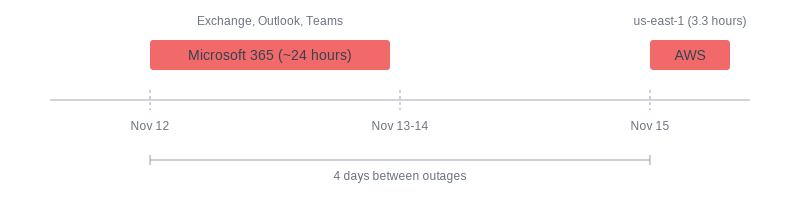
Microsoft 365 failed on November 12, 2026. AWS us-east-1 failed on November 15. Four days apart, no shared infrastructure, different root causes. Officials ruled out a coordinated attack. TechTarget's summary of the week called it "a system under strain."
The Microsoft outage lasted nearly 24 hours. Exchange Online and Outlook stopped working for most users starting at 4:20 PM UTC on November 12. Teams, SharePoint, OneDrive, and other services that touch Exchange were also hit. The cause was a latent bug introduced in July that sat dormant for three months, then surfaced when Teams failed over to a different gateway and 14% of gateway capacity was already offline for unrelated maintenance. Over 80% of the gateway fleet became unresponsive. Microsoft called the failure a combination of the defect, the traffic surge, and reduced capacity happening at once.
AWS us-east-1 had connectivity problems from 3:05 AM to 6:21 AM PST on November 15. IAM Identity Center sign-in failed. Engineers lost their usual path into the AWS Console. CLI sessions that depended on SSO-issued credentials could not refresh. A subset of Network Load Balancers in one Availability Zone cell stayed down until the end. AWS said the issue affected signup, authentication, and connectivity, and that all services returned to normal by 6:53 AM. No root cause was published.
Both outages hit authentication and networking, the layers that let people reach their workloads. A database staying up does not help when the sign-in page times out.
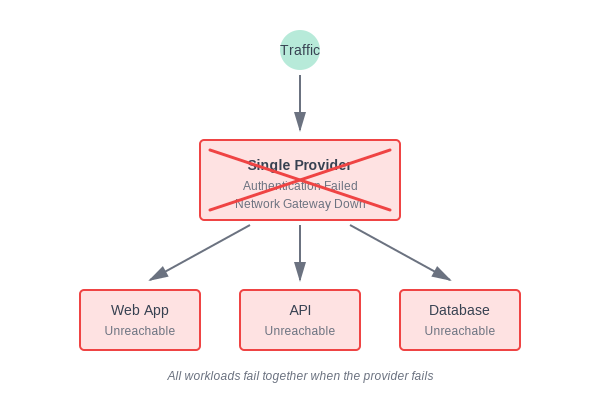
What happens when a single provider fails
A workload that runs entirely on one provider shares that provider's fate. When Microsoft 365 authentication stopped working, people who depended on it for email, calendar access, and document collaboration lost all three at once. A company that runs everything in us-east-1 saw sign-in fail across every service in that region during the same three hours.
The blast radius is the set of things that fail together. Pick one provider, and the blast radius is everything you put there. Microsoft's preliminary post-incident report said the defect went through safe deployment and saturated globally over several weeks with no issues observed. Three months later, the right combination of load and reduced capacity triggered it. Safe deployment did not catch it. Load testing missed it because the test environment used weaker hardware with fewer cores, and the bug was worse on newer machines.
AWS has not published a root cause for the us-east-1 event, so the specific trigger remains unknown. What is known is that IAM Identity Center, the sign-in path for organizations using AWS single sign-on, was unavailable. A detailed breakdown from Control Plane noted that credentials already issued kept working until they expired, but new sign-ins and CLI refreshes failed. Engineers responding to an incident lost their usual access path.
Both failures show that providers with strong track records and extensive testing still hit conditions they did not model in advance. Assume any single provider will fail. The question is how much goes dark when it does.
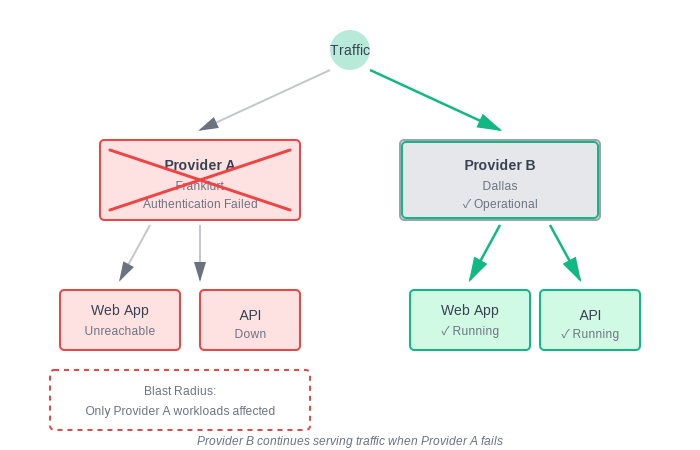
Spreading across independent providers
The alternative is to run workloads on providers that do not share fate. Microsoft and AWS do not use the same authentication layer, the same gateway code, or the same data centers. When Microsoft's gateway fleet failed, AWS kept running. When AWS us-east-1 lost sign-in, Microsoft 365 (once it recovered) stayed up.
Multi-provider compute means VMs or services from more than one hosting company, chosen so that a failure in one does not take down the others. The second provider is not a backup; it is a live system handling traffic. When one fails, the other keeps serving requests.
NodeRings lists plans from independent hosts in different cities. A buyer can pick a VM from one host in Frankfurt and another from a different host in Dallas. The hosts operate separate infrastructure. A networking problem at one host does not affect the VM at the other.
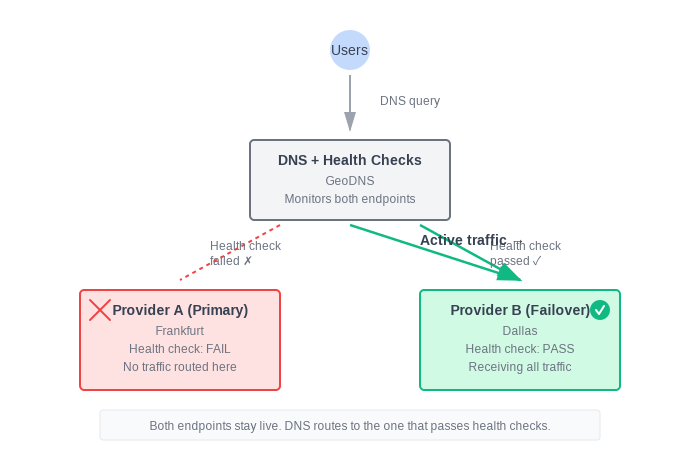
The work is in routing traffic to the right place when one provider is unavailable. DNS failover and GeoDNS are the common tools. Set up health checks that test reachability at each endpoint. When one fails, stop sending traffic there. GeoDNS can route by continent, country, or region, which also helps with latency. NodeRings includes GeoDNS with every account, covering anycast, DNSSEC, and geographic routing without a separate bill. GeoDNS vs anycast for small sites explains how the routing decision works and what each approach requires.
A database primary and a read replica are not independent providers if they sit in the same region on the same cloud. A Kubernetes cluster with nodes in three availability zones still shares the control plane and authentication layer. Split across providers that have different operators, different code, and different physical infrastructure.
Why hosting providers should pitch being the second region
Most production workloads already have a primary deployment. Buyers are not looking to replace what runs; they are looking to limit the blast radius. The pitch for a hosting provider is to be the second region that stays up when the primary goes down.
Large cloud vendors market their redundancy within their own network: multiple availability zones, cross-region replication, managed failover. Those features reduce the chance of failure, but they do not eliminate it. Microsoft 365 and AWS us-east-1 both had internal redundancy. They still went down.
The buyer already knows their primary provider. The decision is where to put the workload that takes over when that provider fails. A smaller host in a different city, with separate infrastructure and no shared authentication layer, fits that need. The sales conversation is shorter when the buyer is already convinced they need a second provider. The question is which one, not whether.
Hosting providers that list on NodeRings can show up in marketplace search when buyers filter by city or compare prices across regions. Plans appear next to other providers, so buyers see the available choices in one place. The NodeRings console manages VMs from different hosts under one account, which simplifies the operational work of running workloads across providers.
What multi-provider deployment looks like in practice
Start with the service that has to stay reachable. A public API, a customer-facing web app, or an internal tool that other systems depend on.
Deploy it on two providers in different cities. Provider A runs the primary. Provider B runs the failover. Both are live. Traffic reaches both, but the primary handles most requests under normal conditions.
Add health checks that test whether each endpoint responds. DNS respects those checks. When the primary fails the health check, DNS stops pointing traffic there. The failover endpoint, which was already running and already tested, takes the full load.
Recovery is the reverse. When the primary passes health checks again, traffic returns. The failover stays up. It is not spun up during an incident; it is already running.
The same pattern works for backend services that other parts of the stack depend on. An authentication service on two providers means sign-in keeps working when one provider is unavailable. A database primary on Provider A with a replica on Provider B lets reads continue when Provider A is down. Writes require more planning, but the blast radius is still smaller than putting everything in one place.
The cost is running workloads in two places instead of one. The operational complexity is managing health checks, keeping both deployments in sync, and testing failover before an incident forces it. Those costs are lower than the cost of being completely unavailable when the primary provider fails.
Why buyers compare providers on NodeRings
A buyer who needs compute from two independent hosts can open accounts with each host directly, manage two billing relationships, and track two sets of credentials. That works. NodeRings consolidates it: one account, one invoice, one place to compare what each host offers.
The marketplace lists Compute Instance plans from hosts in more than 60 cities. Each plan shows the host, the city, the specs, and the price. Buyers can filter by region, compare prices, and deploy VMs without leaving the console. GeoDNS and health-check routing are included, so the DNS layer needed for failover is already there.
A buyer who picks a VM in Dallas from one host and a VM in Amsterdam from another host gets independent infrastructure. The two VMs do not share networking, authentication, or control planes. When one host has an incident, the VM on the other host keeps running.
Providers that list on NodeRings control their own prices and their own infrastructure. NodeRings is the storefront and the order path, not the operator. The VM runs on hardware the provider already manages. Support tickets still go to the host. Buyers get the benefit of comparing providers in one place; hosts get access to buyers who are already convinced they need multi-provider compute.
Lessons from a week of outages
Microsoft 365 and AWS us-east-1 both failed within four days, for different reasons, with no shared infrastructure. The failures were not coordinated. They were separate incidents that happened to land in the same week. TechTarget's reporting noted that security experts found no evidence of a coordinated attack, and that the forensic details pointed to unrelated operational faults.
The week showed that any provider can fail, even providers with strong engineering teams and extensive redundancy. Microsoft's defect sat dormant for three months. AWS has not published a root cause, so the specific failure mode remains unknown. Both outages disrupted authentication and networking, the layers that control access to everything else.
Finding a provider that never fails is not the answer. Spread workloads across providers that fail independently. When Microsoft 365 authentication stopped working, workloads on AWS kept running. When AWS us-east-1 lost sign-in, workloads on Azure, GCP, or an independent host in another region stayed reachable.
Multi-provider compute limits the blast radius. It does not eliminate downtime; it prevents a single failure from taking everything offline at once. For workloads that need to stay reachable, that is the baseline.