
Four dedicated vCPUs are two physical cores. On a host with SMT, the dedicated CPU plans page counts an 8 vCPU plan as 4 physical cores, both threads pinned to the VM, and the same rule at 4 vCPU is 2 cores. The catalog lists an EPYC 9654 and a Xeon E5-2680 v4 at the same 2.4 GHz base. Geekbench 6's processor page for the EPYC 9554, the 9004 part with a published aggregate, prints 1,821 single-core. The E5-2680 v4 page prints 993. The 9654 page prints 0 in that cell.
A line that only says 4 vCPU has put a Genoa core and a Broadwell core under one word. The thread count matches. The cores are a generation apart, and the 9654 page leaves the single-core cell at 0.
What 4 vCPU counts on a dedicated plan
Shared compute schedules vCPUs across host cores that other VMs also use, and the provider can sell more vCPUs than the host has threads. A dedicated plan pins physical cores. Both SMT threads of a core go to the same VM, and the core stays that VM's. The page's picture is an EPYC 9654 with 96 physical cores and 192 threads when SMT is on, and a DC-CPU-8C plan pins 4 of those cores. A 4 vCPU dedicated plan is that picture cut in half, 2 cores and 4 threads.
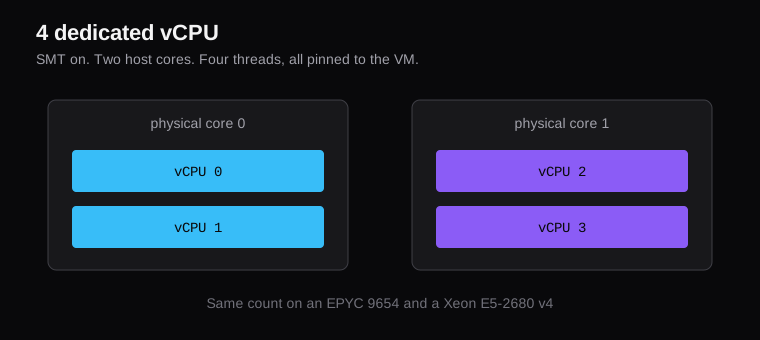
Ryzen 9000 vs EPYC vs Xeon for game servers is the 8 vCPU drawing, because a game tick lives on one thread and that piece left the MSPT cells empty. The Geekbench numbers here are other people's single-core scores. A tick time is a different measurement.
On a host with SMT switched off, the dedicated page says 1 vCPU equals 1 physical core, so a 4 vCPU plan would be 4 cores. The 9654 is sold as 192 threads and the E5-2680 v4 as 28, which is the SMT case. The plan page is the place to see which one you were sold.
Where the 9654 and the E5-2680 v4 sit in the catalog
The catalog page lists 779 CPUs sellable for at least one dedicated category. Base is the general set. HF starts at a 3.2 GHz base, VHF at a base above 3.8 GHz, HP is the recent high-throughput server parts, and GS is desktop and HEDT. HF and VHF use the base clock. Boost stays out of that test.
| CPU | Base GHz | Base | HF | VHF | HP | GS |
|---|---|---|---|---|---|---|
| EPYC 9654 | 2.4 | yes | yes | |||
| EPYC 9554 | 3.1 | yes | yes | |||
| Xeon E5-2680 v4 | 2.4 | yes |
The 9554 misses HF by a tenth. Its catalog base is 3.1, and the HF line starts at 3.2. The 9654 qualifies for HP at 2.4 GHz. The E5-2680 v4 qualifies for Base, and the HF, VHF, HP, and GS cells on that row are empty. A high-frequency filter drops the 9654 and the E5 together. An HP filter keeps the 9654 and drops the E5. A filter that only says 4 vCPU keeps every one of them.
AMD's spec pages are the clock and cache lines. The 9654 is a 9004 part, 96 cores, 192 threads, 2.4 GHz base, 3.55 GHz all-core boost, up to 3.7 GHz max boost, 384 MB of L3, 360 W, DDR5 on 12 channels, 460.8 GB/s. The 9554 is also 9004, 64 cores, 128 threads, 3.1 GHz base, boost up to 3.75 GHz, 256 MB of L3, 360 W, and the same memory rating. The 9755 is a 9005 part, 128 cores, 256 threads, 2.7 GHz base, boost up to 4.1 GHz, 512 MB of L3, 500 W, DDR5 up to 6400 MT/s, 614 GB/s. That one is a different series from the 9004 chips in the title. The usual Geekbench processor URL for the 9755 returned 404, so that row stays blank beside the 9554.
Intel's E5-2680 v4 is Broadwell, 14 cores, 28 threads, 2.40 GHz base, 3.30 GHz turbo, 35 MB cache, 120 W, AVX2, DDR4 on 4 channels, 76.8 GB/s. The E5-2680 v2 is the older pointer. Ivy Bridge, 10 cores, 20 threads, 2.80 GHz base, 3.60 GHz turbo, and the extensions line is AVX. x86-64-v3 is the guest model to use when the part has AVX2, which the v4 lists. On a v2 host the fallback is x86-64-v2-AES, and the v2 page lists AES-NI.
A host writeup prints 2,388 as the average of 10 Geekbench 6 single-core runs on a 4 vCPU, 8 GB, 80 GB guest on a 9654, and the same page calls the 9554 a 3D V-Cache part with an extra 1.1 GB of L3. AMD's 9554 page lists 256 MB of L3. On the Geekbench chart, the 96-core row with the stacked cache is the 9684X, at 1,799 single-core. The 2,388 stays in that writeup.
Geekbench 6 single-core for a 9004 and an E5
The processor pages say the chart is user-submitted Geekbench 6. A banner on the same pages says Geekbench 7 is calibrated to 2,500, the score of a Ryzen 7 7700. The cells here are the Geekbench 6 chart. The single-run pages call Geekbench 6.4 a legacy version and say a comparison stays inside Geekbench 6.
| Part | What was scored | Single | Multi |
|---|---|---|---|
| EPYC 9554 | Processor page, 64 cores | 1,821 | 33,063 |
| EPYC 9654 | Processor page, 96 cores | 0 | |
| E5-2680 v4 | Processor page, 14 cores | 993 | 8,596 |
| E5-2680 v4 | Linux 6.4, 14 cores, 28 threads, AVX2, a HUANANZHI board, result 11729001 | 1,177 | 7,246 |
| E5-2680 v4 | Windows 6.4, 14 cores, AVX2, a QIYIDA board, base field 2.39 GHz, max 3292 MHz, result 12702305 | 1,118 | 7,256 |
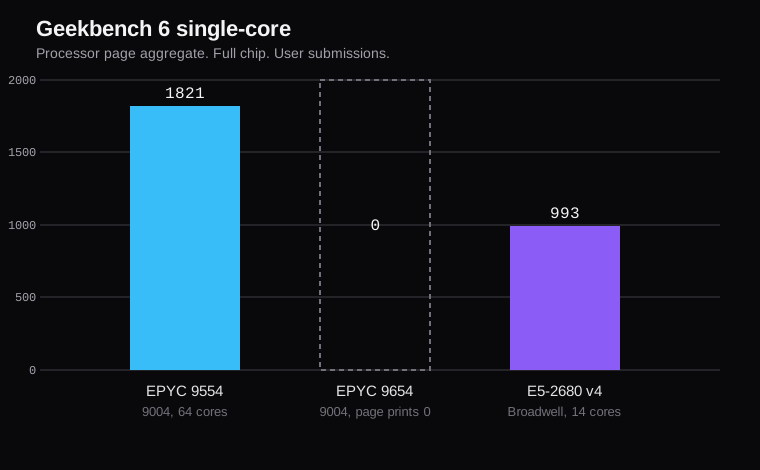
The two full-chip runs sit higher than the 993 aggregate. The aggregate is every upload folded into the processor page, guests included. The Linux upload stores 3.30 GHz in the base-frequency field. Intel's base for this part is 2.40 GHz. The Windows upload stores 2.39 GHz base and a 3292 MHz maximum, which is the turbo. Use the Windows frequencies when you want the spec, and treat the Linux 3.30 as the field that upload wrote down.
The machine in front of me reports an Intel Core i7-1185G7E under KVM, the same chip as the game-server note, on the lab node from the restore times piece. A score taken here would be that laptop part. The table stays with the browser pages.
A 4 vCPU EPYC that scored 867
A LowEndTalk thread asks why an EPYC VPS felt 3 to 5 times slower than a Xeon VPS. The EPYC paste is a 4-core KVM guest whose model line reads AMD EPYC Processor (with IBPB). Geekbench 6.3.0 for Linux scored it 867 single-core and 2,392 multi-core. The result names the machine Virtuozzo KVM, prints AuthenticAMD Family 23 Model 1 Stepping 2, a 2.80 GHz base, 512 KB of L2 on each of the 4 cores, and 7.75 GB of RAM.
AMD's AOCL guide maps family 23, models 1 through 47, to first-generation EPYC, Naples, Zen. Genoa, the 9004 series, is family 25. The guest in that thread is a first-generation part with the product string replaced by a generic one. Four cores, and the word EPYC.
The Xeon paste beside it is a 2-core guest. Geekbench names it a Xeon Gold 6152, Family 6 Model 85, Geekbench 6.3.0, 836 single-core and 1,435 multi-core, result 9938633. Single-core, those two pastes are 867 and 836. The 3 to 5 times is how the site felt. The replies on the thread point at overselling. The CPU scores sit next to each other, and the EPYC one is Naples, which is a different chip from a 9654.
A bare 4 vCPU line can hide a 9004 core, a Broadwell core, or a Naples core whose name was stripped. Once the guest is yours, the family line and a Geekbench 6 single-core score separate those three.
lscpu
vmstat 1 5
vmstat prints an st column. Time there is time the guest was ready to run while the host ran someone else. On a shared plan, that column is the evidence the 4 threads were waiting. On a dedicated plan the cores are pinned, and the docs say those cores stay with that one VM. A steal reading from a 9654 or an E5 was left for the guest you are about to pay for.
Set the guest to x86-64-v3
The lab node's QEMU capabilities list has 73 CPU models. The generic names in it are host, kvm64, qemu64, x86-64-v2, x86-64-v2-AES, x86-64-v3, and x86-64-v4. Guest 15911 was created with 4 cores and x86-64-v3, the config was read, and the guest was destroyed. It stayed powered off. The config held cores, cpu, memory, and ostype. The host under that config is the i7-1185G7E, so the lines are the menu on that chip.
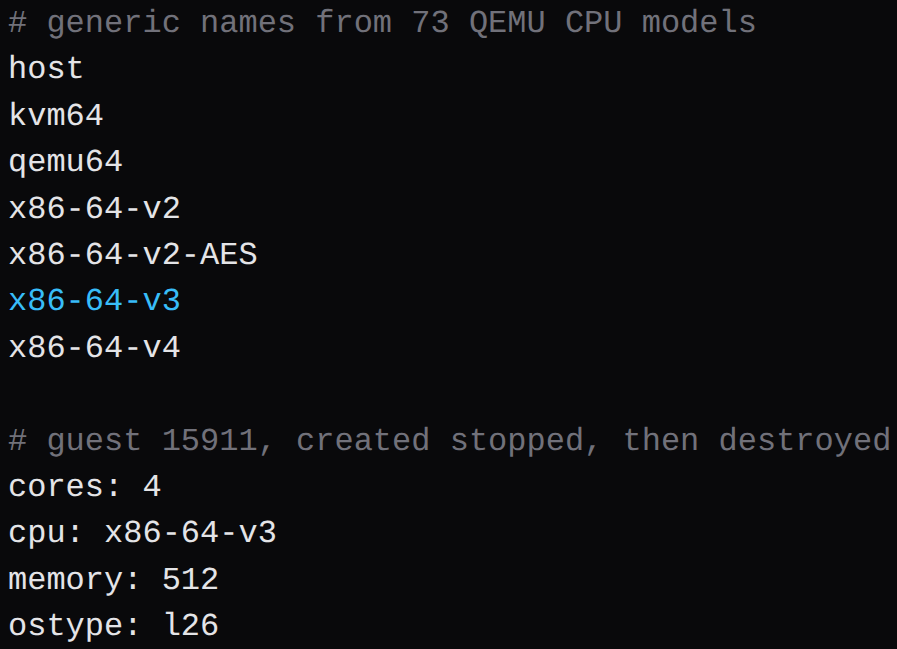
On a guest that already exists, shut it down and start it so QEMU is created again with the model in the file. The id here is the one that was created and removed.
qm set 15911 --cores 4 \
  --cpu x86-64-v3
qm shutdown 15911
qm start 15911
If the guest fails to start on x86-64-v3, the host flags are short of that model. x86-64-v2-AES is the fallback, and this node lists it too. host passes through the flags of the chip the node actually has. On this node that chip is the i7. kvm64 is the generic 64-bit model. A catalog row that says EPYC 9654, paired with a guest whose lscpu model is kvm64, is two products under one label.
lscpu is where the family and the model show up. Family 25 is the Genoa range in the AOCL guide. Family 23 model 1 is the Naples guest from the thread. The E5-2680 v4 results identify as GenuineIntel Family 6 Model 79. The Gold 6152 result is Family 6 Model 85. The plan's 4 vCPUs are 4 threads on 2 host cores when SMT is on. What lscpu prints for cores and threads is the topology QEMU advertised, which can be 4 single-thread cores even when the pin underneath is 2. The family line is the part.
What the listing still has to name
The SKU, the catalog base, and whether the cores are pinned or shared. Then the model line inside the guest. A Geekbench 6 single-core score is the check when one thread is the thing being bought. Four dedicated vCPUs are 2 cores on a 9654 and 2 cores on an E5-2680 v4. The 9554's public single-core aggregate is 1,821. The E5-2680 v4's is 993. The 9654 cell prints 0, so a 9654 claim still wants a model line and a run of its own.
The multi-core column is the whole chip, 33,063 on a 64-core 9554 and 8,596 on a 14-core Broadwell, while a 4 vCPU guest has 4 threads. The single-core number is the one that describes each of them, until st says the host gave the time to somebody else.