
Enzonix
Shared Compute - General Compute
$5.00/mo
1 vCPU · 1 GB · 20 GB
Choose location
Ashburn, United States
| Provider | Plan | vCPU | RAM | Disk | Regions | Billing | Price |
|---|---|---|---|---|---|---|---|
| Enzonix | Shared Compute - General Compute | 1 | 1 GB | 20 GB | Ashburn, United States | Fixed price | $5.00/mo |
| Enzonix | Shared Compute - General Compute | 1 | 1 GB | 20 GB | Amsterdam, Netherlands | Fixed price | $5.00/mo |
| Enzonix | Shared Compute - General Compute | 2 | 4 GB | 80 GB | Amsterdam, Netherlands | Fixed price | $9.00/mo |
| Enzonix | Shared Compute - General Compute | 2 | 4 GB | 80 GB | Ashburn, United States | Fixed price | $9.00/mo |
| Enzonix | Shared Compute - General Compute | 4 | 8 GB | 160 GB | Amsterdam, Netherlands | Fixed price | $16.00/mo |
| Enzonix | Shared Compute - General Compute | 4 | 8 GB | 160 GB | Ashburn, United States | Fixed price | $16.00/mo |
| Enzonix | Shared Compute - General Compute | 8 | 16 GB | 320 GB | Amsterdam, Netherlands | Fixed price | $32.00/mo |
| Enzonix | Shared Compute - General Compute | 8 | 16 GB | 320 GB | Ashburn, United States | Fixed price | $32.00/mo |
| Enzonix | Shared Compute - General Compute | 1 | 1 GB | 20 GB | Ashburn, United States | Hourly | $0.007/hr |
| Enzonix | Shared Compute - General Compute | 1 | 2 GB | 40 GB | Ashburn, United States | Hourly | $0.01/hr |
| Enzonix | Shared Compute - General Compute | 2 | 4 GB | 80 GB | Ashburn, United States | Hourly | $0.015/hr |
Marzneshin Instant App
Marzneshin is a multi-user panel with a colocated Xray node, VLESS Reality, Shadowsocks, and a ready first user. Compare live prices, deploy, and connect from v2rayNG, Hiddify, Streisand, or Clash Meta.

Marzneshin
Instant App on marketplace VPS
Live marketplace offers
Choose billing and size, compare providers side by side, pick a location, then launch.
Shared Compute - General Compute
$5.00/mo
1 vCPU · 1 GB · 20 GB
Choose location
Ashburn, United States
1 provider
Marzneshin is the web panel. Behind it, colocated marznode runs Xray-core, which accepts VLESS Reality and Shadowsocks and forwards traffic. Users get a subscription URL. This Instant App creates the owner admin and the first user, both named noderings, with no form fields at create time. For production camouflage, point a CDN hostname at the VPS and update Hosts after deploy.
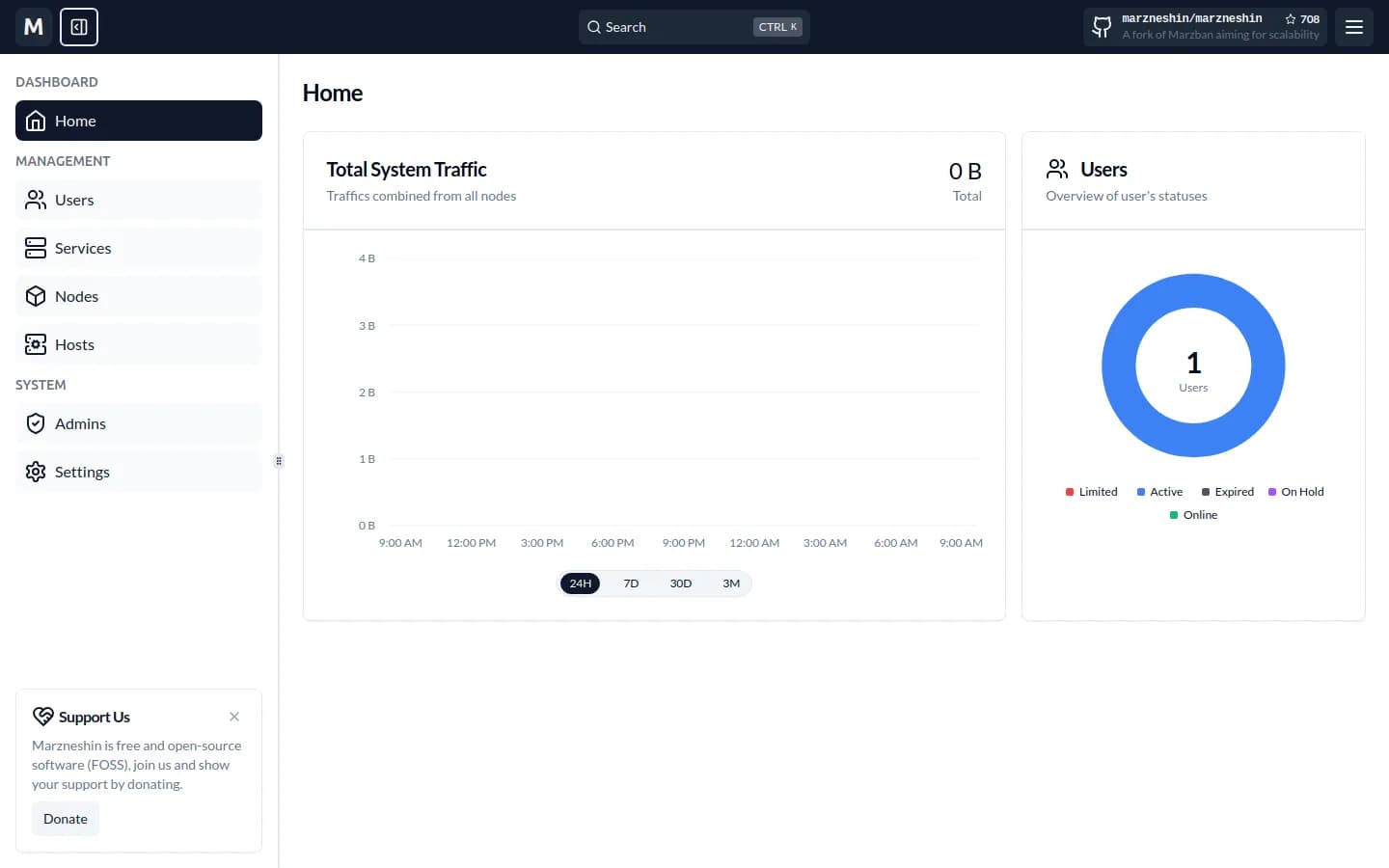
After sign-in you land on Users with active counts, data usage, and memory. The panel is Marzneshin. The VPN work happens on Xray inside the colocated marznode.
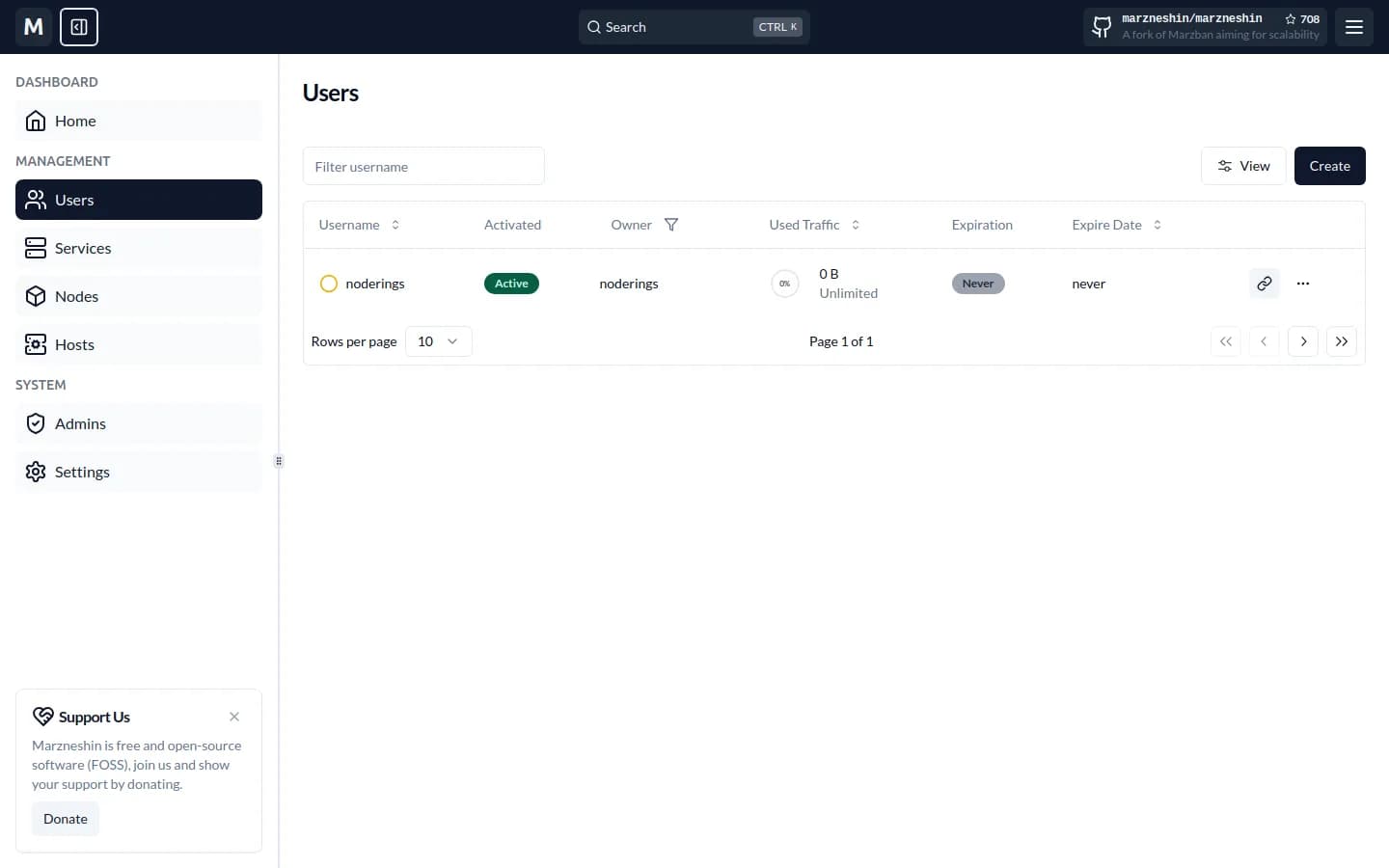
Each user is assigned to inbounds. The Instant App creates noderings with VLESS Reality and Shadowsocks. Copy the subscription URL or QR from the user row.
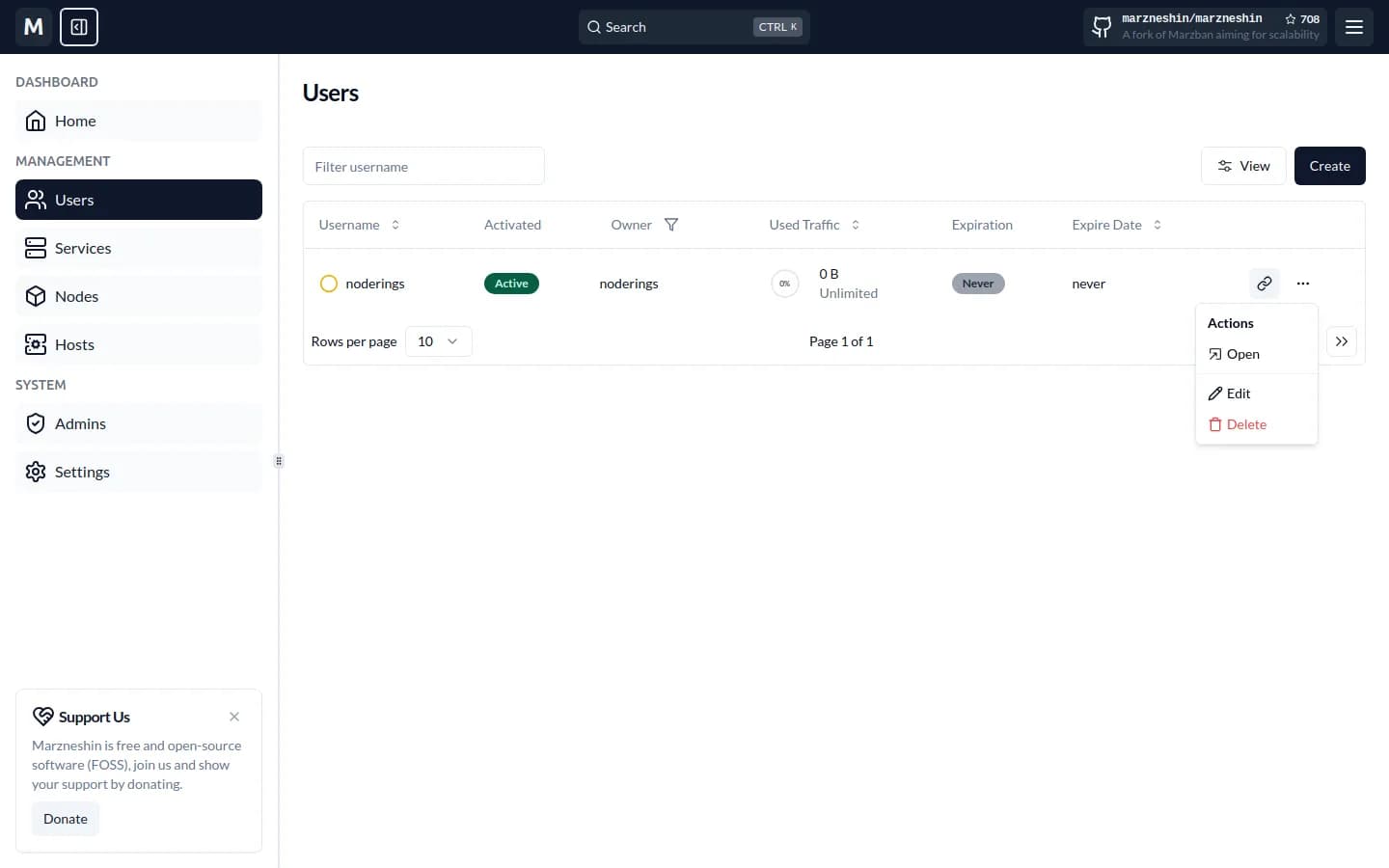
Open the link or QR actions on a user to hand out a subscription. The first subscription is marzneshin_subscription_url in the credentials file.
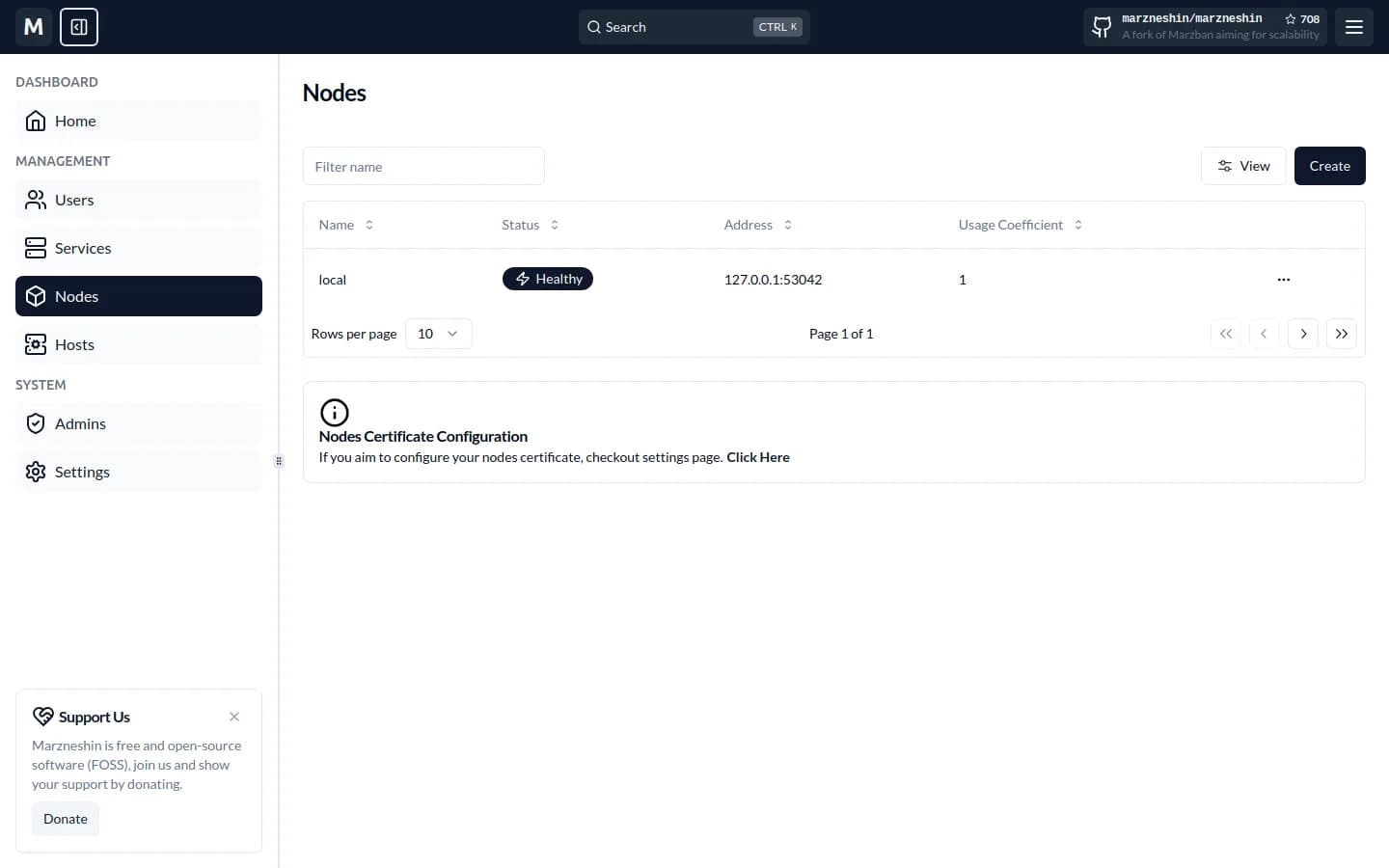
Core Settings edits the Xray JSON on this VPS (VLESS Reality and Shadowsocks ready). Hosts control the addresses clients see. Attach Marzneshin-node workers later for extra edge capacity.
Xray-core
Marzneshin stores users, hosts, and admins. Xray-core runs inside the Marzneshin container and listens for VLESS Reality, Shadowsocks, and any other inbounds you add to the core config. A panel login with no imported subscription leaves the phone on its normal connection.
After the VPS is up, sign in as the owner, change the password, and confirm the ready subscription is the one you want to hand out.
01
In a browser, open marzneshin_panel_url from the credentials file (HTTPS on port 8000, /dashboard/). Accept the self-signed certificate warning for the sslip.io name.
02
SSH in as root with the create-flow password or key. The file lists the owner password, the panel URL, the domain, the first subscription URL, and marzneshin_core=xray.
cat /root/.noderings_password03
Use noderings and marzneshin_admin_pass from that file. Change the password in the panel before you leave the login on the public internet.
04
TCP 22 is SSH. TCP 8000 is the panel. TCP 8443 is VLESS Reality. TCP 1080 is Shadowsocks. TCP 53042 is marznode gRPC (keep it private to the VPS when you can).
05
VLESS Reality on 8443 (SNI www.cloudflare.com) and Shadowsocks on 1080. Hosts point at the VPS IPv4. Add a CDN hostname under Hosts when you want clients to use a camouflage name.
A user is assigned to inbounds. The Instant App creates the first one. You create the rest in the panel.
01
In the panel, open Users. The first user is noderings with the ready Reality and Shadowsocks inbounds.
02
Use Create User. Select the VLESS Reality and Shadowsocks inbounds (or others you add). Set a traffic cap or expiry when you need them.
03
From the user row, open the link or QR actions. For the first user, marzneshin_subscription_url is already in the credentials file.
04
Importing one subscription on a phone and a laptop counts as one user. Add a separate user when you want a separate quota or a clean revoke.
05
Disable or delete that user in the panel. The panel updates the Xray node. The old subscription stops working after the sync.
You import a subscription URL, a VLESS Reality link, or a QR code. Then you turn the tunnel on in the client app.
01
Android: v2rayNG or Hiddify. iOS: Hiddify, Streisand, Happ, or Shadowrocket. Windows: v2rayN, Happ, or Hiddify. macOS and Linux: Hiddify, Happ, or Clash Verge Rev with a Clash subscription.
02
Paste marzneshin_subscription_url, scan the QR from the panel, or import a single VLESS Reality line. The first subscription is in the credentials file.
03
Select that profile and turn the tunnel on. Allow the VPN permission the phone asks for.
04
Open a page that shows your public IP and compare it with the VPS address. In the panel, the user should show as online. If the IP did not change, the tunnel is not carrying traffic.
05
Confirm TCP 8443 is open and the host in the link is the VPS IP, not 127.0.0.1. Accept the panel’s self-signed cert only for admin HTTPS. A Reality client with the wrong clock often fails the handshake — set the phone time to automatic and try again.
These apps run on the phone or computer. They are not Instant Apps. Import a subscription from this server. The ready inbounds are VLESS Reality and Shadowsocks over Xray.

Android. Import the subscription or paste a VLESS Reality link.

Android client built on sing-box. Imports the same subscription.

The Hiddify app, separate from Hiddify Manager. Imports a subscription.

iOS, and macOS on Apple silicon. Imports the subscription or VLESS link.

Phone and desktop builds. Imports the subscription.

Paid iOS app. Imports the subscription or VLESS link.

Windows client from the v2rayN project. Add the subscription URL.

Use when you prefer a Clash-compatible subscription from Marzneshin.
A VPS in a region you pick is an exit for traffic you send through Marzneshin. On a filtered ISP, the result depends on the hostname, CDN, Reality settings, and what that network blocks. First boot uses sslip.io without a CDN.
| Situation | Fit | What to expect |
|---|---|---|
| Everyday privacy exit | Depends on the network | Useful when you want traffic from a phone to leave through a VPS you picked. The hosting provider can see that server. |
| Filtered networks in Iran | Often used | Marzneshin is commonly used as a Marzneshin-class multi-user panel with Reality and subscription clients. The ready Reality inbound is a stronger start than plain VLESS. A CDN hostname still helps. Test on your own line. |
| China (GFW) | Depends on the network | People test Reality destinations, shortIds, and CDN hosts. Expect to tune Hosts and the core config. No guarantee. |
| Russia and other filtered ISPs | Depends on the network | Sometimes chosen when a network filters WireGuard or OpenVPN. The protocol and hostname still have to pass that ISP. |
| OpenVPN-only or office VPN profiles | Poor match | OpenVPN Connect will not import a Marzneshin subscription. This Instant App hands out Xray-style links. |
Compare live Marzneshin VPS plans from independent providers, then run the multi-user panel with a colocated Xray node on the offer you pick. Use it instead of paying for a commercial multi-user Xray panel or a retail VPN subscription.
See live prices, regions, and plan sizes before you buy. Shop self-hosted multi-user Xray panel hosts across independent providers.
Deploy Marzneshin and the VPS comes up with the panel, a colocated marznode, VLESS Reality, Shadowsocks, and a ready subscription URL. You still get root SSH.
The provider region is the geography of the VPS address clients will use. Add a CDN domain in Hosts later when you want camouflage in front of that address.
The owner password and the first user subscription URL are written on the server. You change the password, revoke users, and decide which hosts stay active.
Most Marzneshin install guides assume one server you already own. NodeRings lists Compute Instance plans from independent providers so you can compare self-hosted multi-user panel offers by price, size, and region, then launch on the one that fits.
Marzneshin Instant App prepares the panel and colocated marznode on the provider VPS you selected. The provider operates that machine. NodeRings lists the plan and deploys the Instant App.
Compare plans, pick a provider offer, and launch Marzneshin on that server.
01
Pick a provider offer. A sensible start is 2 vCPU, 2 GB RAM, and 20 GB disk. Smaller and larger plans stay on the list.
02
Launch the Instant App on that plan. The panel and colocated marznode come up together. There are no extra form fields.
03
Read marzneshin_subscription_url from the server, import it in v2rayNG, Hiddify, Streisand, or another app below, and confirm the tunnel from the phone.
NodeRings Instant App installs Marzneshin panel and marznode with Docker on the host network, creates the sudo admin, installs VLESS Reality and Shadowsocks, and writes the first subscription URL.
Credentials are written on first boot to:
/root/.noderings_passwordRead them over SSH:
cat /root/.noderings_passwordMarzneshin Compose project
/opt/noderings/marzneshindocker-compose.yml, .env, data/, and node-data/.
Credentials file
/root/.noderings_passwordWritten on first boot. Includes the owner password and the first subscription URL.
Install log
/tmp/marzneshin-admin.logBootstrap output from the Instant App first-boot script.
Compose runs dawsh/marzneshin and dawsh/marznode on the host network. Xray-core runs inside marznode.
marzneshinPanel API and dashboard on HTTPS :8000.
marznodeColocated node with Xray-core (VLESS Reality, Shadowsocks, and more).
Container status
cd /opt/noderings/marzneshin && docker compose psLive logs
cd /opt/noderings/marzneshin && docker compose logs -fRestart stack
cd /opt/noderings/marzneshin && docker compose restartThe panel already serves HTTPS on :8000 with a self-signed cert for sslip.io. Client tunnels use Reality or Shadowsocks on their own ports. A CDN hostname is for the address you put in Hosts, not a Flexible SSL path through the panel port.
Add your domain
Sign up at a CDN such as Cloudflare and add the domain you want clients to see in subscription links.
Point it at your VPS
Create an A record to your server IP. For Reality, many operators leave the record DNS-only; for TLS camouflage setups, follow the Marzneshin docs for that inbound.
Update Hosts in Marzneshin
In the panel, open Hosts and set the address or SNI fields so new subscription links use that hostname. Re-issue or refresh client subscriptions.
Keep proxy ports open
Phones still need TCP 8443 (and 1080 if you use Shadowsocks) reachable on the VPS, unless you terminate those elsewhere.
Keep port 22 allowed for SSH. Keep 8000 reachable if you administer from the public internet, or bind admin access behind SSH otherwise.
Marzneshin runs the panel and a colocated Xray node. CPU and RAM matter more once several users are online. These rows are starting points, not a filter on the plans above.
| Workload | Illustrative starting point | Note |
|---|---|---|
| One or two phones | 2 vCPU, 2 GB RAM, 20 GB disk | Matches the Instant App floor. Enough for the panel, Xray, and a personal subscription. |
| A household or a small team | 2 vCPU, 2–4 GB RAM, 20 GB disk | More headroom when several clients are online and you add inbounds. |
| Many subscription users | 4 vCPU, 4–8 GB RAM, 40 GB disk | CPU and the provider's bandwidth cap show up before disk does. Attach Marzneshin-node workers when you need more edge capacity. |
Illustrative only. Live plans are not filtered by this table. A filtered network can still block a tunnel that fits on a small VPS.
You get root on a provider VPS. NodeRings lists the plan and deploys Marzneshin. The provider runs the machine.
Owner password, which hosts and users exist, who receives a subscription, the host firewall, and the provider's terms. Add a CDN hostname if that is what you want on the public internet.
The VPS, the network, and the exit IP. Abuse on a public proxy port can get that provider to suspend the server.
The marketplace and the Instant App that deploys Marzneshin with a colocated marznode. NodeRings does not run a VPN service and does not see client traffic.
v2rayNG and NekoBox on Android. Hiddify on Android, iOS, Windows, macOS, and Linux. Streisand on iOS and macOS. Happ on phone and desktop. Shadowrocket on iOS. v2rayN on Windows. Clash Meta when you use a Clash-compatible subscription. OpenVPN Connect will not import Marzneshin links.
People commonly run Marzneshin-class panels with VLESS Reality and subscription clients when an ISP filters ordinary VPN apps. A line connects when the hostname, the client, and that ISP still match. First boot uses Reality plus sslip.io hosts without a CDN. Update Hosts and test on your own connection. No unblock guarantee.
Create another user, or import the same subscription on a second device. One shared subscription counts as one user. To stop a device, disable that user or rotate its subscription.
Marzneshin is a scale-oriented Marzban fork with a separate marznode process (Xray). PasarGuard and Remnawave are other panel families. This Instant App installs panel + node on one VPS.
You rent a VPS and run Marzneshin yourself. You choose the region, the hosts, and who gets a subscription. The VPS provider can see the server. NodeRings lists plans and deploys the Instant App.
TCP 22 for SSH, TCP 8000 for the panel, TCP 8443 for VLESS Reality, and TCP 1080 for Shadowsocks. TCP 53042 is marznode gRPC for the colocated node.
NodeRings lists provider plans and deploys the Instant App onto the plan you pick. The provider operates the VPS. You operate Marzneshin and its marznode.
A subscription URL for the first user, named noderings. Import it to pull VLESS Reality and Shadowsocks links from Xray. marzneshin_core in the same file is xray.
Xray-core on the colocated marznode. The web UI configures users, hosts, and the core. Xray applies that config and accepts client connections.
Marzban Instant App
Original Gozargah panel with embedded Xray on the same VPS.
PasarGuard Instant App
Newer Marzban-family panel with a colocated Xray node on the same VPS.
Remnawave Instant App
Marzban-compatible panel with HWID limits and a colocated Xray node.
Hiddify Manager Instant App
All-in-one anti-censorship panel with Xray and sing-box on the same VPS.
3X-UI Instant App
The Sanaei panel with Xray-core on the same VPS.
S-UI Instant App
The Alireza panel with sing-box on the same VPS.
Libertea Instant App
Multi-protocol panel with Xray providers, Shadowsocks, and camouflage routes.
All Instant Apps
Browse every Instant App landing on Compute Instance.