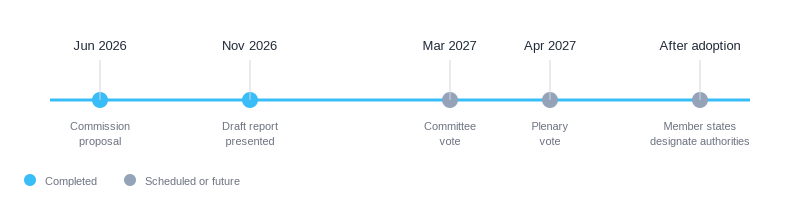
European lawmakers introduced a draft report on the Cloud and AI Development Act on November 13, 2026. The proposal sets four assurance levels for public cloud procurement, with each level tightening requirements around data location, ownership, supply-chain transparency, and third-country control. The Commission published the full legislative text on June 3, 2026. Parliament committees are scheduled to vote in mid-March 2027, with a plenary vote expected in April.
The proposal comes at a moment when three non-European hyperscale providers control more than 70% of the European cloud market, according to the Commission. In June 2026, the US ordered Anthropic to block access to its Claude Fable 5 and Mythos 5 models from outside the US. Access returned later that month, but the incident reinforced concerns that critical European infrastructure runs on services a foreign government can switch off. Dutch green MEP Reinier Van Lanschot said during the November 13 press conference: "Our critical systems run on someone else's technology, and someone else can switch it off. Today a court, tomorrow a ministry, a hospital, a grid operator?"
The assurance levels give public buyers a framework for matching risk to control. They also create a pathway for European hosting providers to compete for contracts that once went to hyperscalers by default.
The four assurance levels
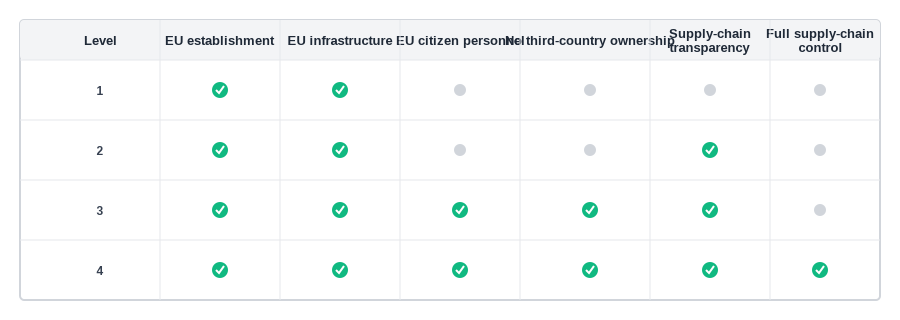
The levels are cumulative. A provider aiming for Level 2 must meet all Level 1 criteria first, then add the Level 2 requirements. The text is Annex II of the regulation.
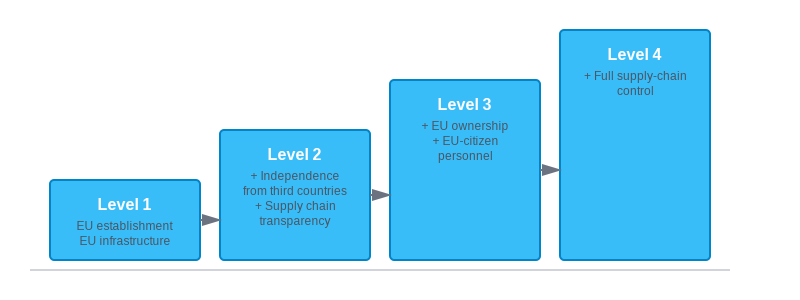
Level 1: EU establishment and data residency
A provider is established in the EU. Infrastructure, assets, and customer data stay within the Union unless the public buyer explicitly allows otherwise. Support can be outsourced to third countries if traceability and governance measures prevent that support from compromising operational autonomy. The provider demonstrates state-of-the-art cybersecurity, discloses all subcontractors, and subjects them to due diligence.
If the provider is subject to third-country control, it must guarantee that no law in that country requires reporting software vulnerabilities to foreign authorities before those vulnerabilities become publicly known.
Level 1 is a self-assessment. No independent audit is required.
Level 2: Supply-chain transparency and independence
The provider and all subcontractors are established in the EU. Infrastructure, assets, and personnel are located in the Union. The service obtains at least a "substantial" cybersecurity certificate under the European Cybersecurity Certification Scheme, once that scheme exists. Until then, national schemes apply where available.
Customer data cannot be used to train or fine-tune any AI system operated by a third country or an entity established in one. Technical and operational support stays within the EU. The provider documents a complete software bill of materials (SBOM) and lists identified dependencies. Where software components come from third-country manufacturers, the provider implements controls to block remote features that could tamper with or disrupt the service, audits security-relevant components at the source-code level, and documents a migration plan if the vendor fails or a third country imposes restrictions.
If the provider or its subcontractors are subject to third-country control, they must demonstrate that the control does not restrict the provider's ability to deliver the service, does not allow access to customer data, cannot disrupt service continuity, and does not force compliance with foreign sanctions unless those measures are legitimate under EU or member-state law.
Level 2 requires an independent third-party audit.
Level 3: EU ownership and EU-citizen personnel
The provider and subcontractors are established in the EU. Infrastructure, assets, and personnel are located in the Union. Personnel are EU citizens, and where appropriate, they hold security clearance issued by a member state when handling classified information.
The provider and its subcontractors are not subject to third-country control. A derogation exists: the Commission can recognize a third-country-controlled provider through an implementing act if the provider demonstrates that the control does not restrict delivery, prevent access to customer data, or force compliance with foreign sanctions.
Support is performed exclusively within the EU by EU residents working for entities not subject to third-country control. SBOM and dependency documentation are required, with the same source-code audits and migration plans as Level 2.
Level 3 requires an independent third-party audit.
Level 4: Full supply-chain control
Level 4 adds a "high" cybersecurity certificate. The provider demonstrates that no third country or entity established in one holds effective control over the design, development, maintenance, and evolution of software components used in the service. Effective control includes the ability to influence technical evolution, maintenance priorities, security remediation, and long-term continuity.
Personnel requirements, data residency, support location, and the prohibition on third-country ownership remain the same as Level 3.
Level 4 requires an independent third-party audit.
Where independent European hosts fit
An independent hosting provider with servers in one or more EU cities, EU-established legal status, and EU-based technical support can qualify for Level 1 by documenting where data sits, listing subcontractors, and demonstrating cybersecurity compliance. Level 1 does not require an audit, which keeps the compliance cost lower than the higher levels.
Level 2 is where costs climb. The requirement for source-code audits on third-country software creates a bottleneck that falls hardest on smaller providers. If a provider uses licensed virtualization, networking, or operating-system software from vendors such as VMware, Cisco, or Microsoft, the provider cannot compel those vendors to open their code for audit. A hyperscaler that writes its own stack can open the code to auditors. An independent provider running the same licensed components cannot. The Cloud Infrastructure Services Providers in Europe (CISPE) noted in its November 2026 consultation response that this criterion rewards the third-country dependency the regulation aims to reduce.
Level 3 and Level 4 require EU ownership and control. A provider backed by non-EU investors or operating as a subsidiary of a third-country parent would not qualify unless the Commission grants a derogation. The German SME association BVMW argued in its July 2026 position that the control test should focus on where strategic decisions are made and where operational value is created, rather than formal ownership structure alone, to avoid penalizing European startups with international funding.
For a provider that meets the ownership and personnel requirements, Level 3 remains within reach. Level 4 is designed for the highest-sensitivity workloads and requires control over the entire software supply chain. Few providers will target it outside of government and defense contracts.
The public-procurement pathway
The assurance framework matters because public-sector buyers will be required to use it. Member states and EU entities conduct risk assessments of their workloads. The assessment determines the minimum assurance level for each procurement. A ministry running citizen identity services would assess that workload as high risk and require Level 3 or Level 4. A city's parking-fine database might land at Level 1.
Once the risk assessment sets the level, the buyer can only purchase services from providers recognized at that level or higher. Recognition comes from a member state's competent authority, after the provider submits documentation (Level 1) or undergoes an independent audit (Levels 2 through 4). The recognition is EU-wide: a provider recognized in one member state can bid for contracts in any other.
The proposal does not ban private buyers from using non-EU providers. It applies only to public procurement and to private entities deemed essential or important under the NIS2 Directive when they are purchasing cloud services for critical functions.
What this means for buyers on NodeRings
A buyer shopping for VMs on NodeRings can filter by city and compare plans from independent hosts in Amsterdam, Frankfurt, Paris, and other European cities. Many of the listed hosts are EU-established entities with EU-located infrastructure. Whether a given host qualifies for Level 1 or higher depends on its ownership structure, the location of its personnel, and how it documents its supply chain.
A private buyer does not need to match a risk assessment to an assurance level. The levels are designed for public procurement. A private company can choose an EU-located host for data residency, latency, or cost, without worrying about whether the host has been audited for Level 2 or Level 3.
A public buyer, once the regulation takes effect, would check whether the host has been recognized at the required level. If the buyer's risk assessment calls for Level 1, any EU-established host with EU infrastructure and documented cybersecurity can compete. If the buyer needs Level 3, the host must also be EU-owned and staffed by EU citizens, and must have passed an independent audit.
NodeRings simplifies the operational side: one account, one invoice, and GeoDNS with health checks built in. The sovereignty assurance is between the buyer and the host. NodeRings lists the host's city and legal establishment. The buyer confirms the host's recognition status with the member state's competent authority.
Positioning for public-sector contracts
A European hosting provider that wants to compete for public contracts should start by determining which level it can realistically reach. Level 1 is accessible to most EU-established providers with EU infrastructure and EU-resident technical staff. The documentation burden is lighter than the higher levels, and no audit is required.
Level 2 becomes feasible if the provider controls its software stack or can negotiate source-code access with its vendors. Providers that depend on widely licensed third-country software may find the source-code audit requirement impossible to meet without changing their stack. CISPE recommended that the regulation recognize existing certifications such as EUCS, BSI C5, SecNumCloud, and ENS Alto, so that a provider does not pay twice for the same audit. The BSA echoed that view in October 2026, noting that additional audits fall hardest on smaller providers, which absorb recurring certification costs less easily than large incumbents.
Level 3 requires EU ownership and EU-citizen personnel. A provider that meets those criteria and has already passed a Level 2 audit would add the personnel documentation and the ownership attestation. The technical stack requirements are the same as Level 2, so the incremental cost is the additional audit scope.
Level 4 is reserved for workloads where the buyer needs full assurance that no third country can influence the software supply chain. Unless the provider writes its own virtualization layer, networking stack, and operating system, or uses open-source components with documented controls, Level 4 is out of reach.
The pitch to public buyers is straightforward. An independent European host offers local data residency, no hyperscaler lock-in, and a recognized sovereignty level that matches the buyer's risk assessment. For a public agency that assessed its workload as Level 1, the host's EU establishment and EU infrastructure are enough. For a higher-risk workload, the host's audit and recognition status are the proof the buyer needs.
Listing on NodeRings makes the host visible to buyers who are comparing options across cities and price points. The marketplace shows each plan's city, specs, and host. A buyer filtering for Amsterdam sees every listed host with capacity there. The buyer then confirms the host's sovereignty recognition status before contracting.
The timeline and what comes next
The Commission published the proposal on June 3, 2026. The European Parliament referred it to committees on September 17, and a draft report was presented on November 13. The legislative observatory shows the file awaiting committee decision. A committee vote is provisionally scheduled for mid-March 2027, followed by a plenary vote in April.
Once the regulation takes effect, member states designate competent authorities to recognize providers. Providers submit documentation or undergo audits. Public buyers conduct risk assessments and set minimum assurance levels for their contracts. The framework becomes binding on public procurement at that point.
For providers, the preparation is immediate. An EU-established host with EU infrastructure can document its compliance with Level 1 criteria now. If the host plans to compete for contracts requiring Level 2 or higher, it should inventory its software stack, identify third-country dependencies, and determine whether source-code audits are feasible or whether the stack needs to change. Providers with non-EU ownership should evaluate whether their structure allows a derogation under Level 3, or whether restructuring is necessary.
For buyers, the regulation formalizes what many already treat as best practice. Data sovereignty and vendor independence have been procurement considerations for years. The assurance levels standardize the criteria and the recognition process across the EU, so a buyer in Spain can trust a provider recognized in Germany without conducting its own audit.
The Cloud and AI Development Act gives European hosting providers a framework to compete for public contracts that previously defaulted to hyperscalers. The levels are cumulative, the audit requirements escalate sharply after Level 1, and the compliance costs differ by provider size and stack. The pathway exists. The question for each provider is which level it can reach and how soon it can document or audit its way there.