
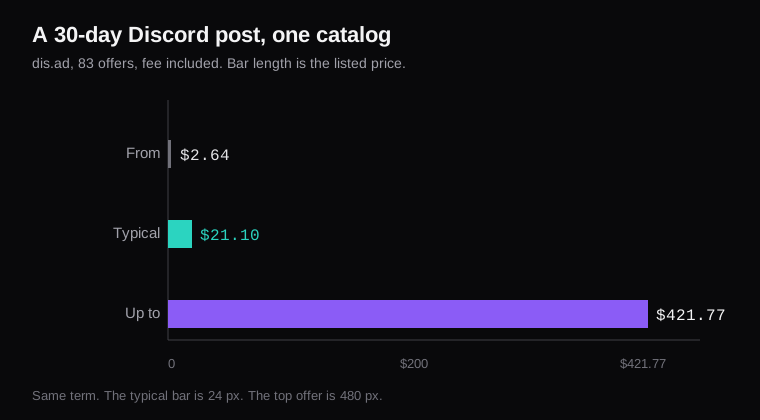
A public catalog of Discord communities lists 83 offers for a 30-day post. The cheapest is $2.64, the typical price is $21.10, and the highest is $421.77. The marketplace fee is already inside those three numbers. What that money buys is a message in someone else's server, kept up for the term, with an @everyone or an @here on it.
A YouTube creator is a separate purchase. The price is the rate card that creator sends. The catalog is the range a community owner has already published. The creator's fee shows up when you ask, in writing, for that one channel.
The review profiles people treat as a billboard are a third object. BisectHosting's Trustpilot page shows 4.7 from 27,344 reviews. Apex Hosting shows 4.5 from 8,171. Shockbyte shows 4.2 from 10,388. A paid mention is one video, or one Discord post. Those counts are years of customers.
What a 30-day Discord post costs
The page is dis.ad. The figures here are that catalog: 48 servers and 1,517,479 members. Each owner sets a price. The low, the typical, and the high are what the page prints for each term it sells, with the fee included.
| Term | Offers | From | Typical | Up to |
|---|---|---|---|---|
| 3 days | 80 | $0.99 | $5.35 | $42.18 |
| 7 days | 85 | $1.87 | $9.58 | $168.71 |
| 30 days | 83 | $2.64 | $21.10 | $421.77 |
A 3-day post can be $0.99. A 30-day post at the typical price is $21.10. The same 30-day term also contains an offer at $421.77, which is 19.99 times the typical listing. Same shape of product, same length of time, a price that depends on which community you picked.
The page is plain about the unit. You pay for a post, for a number of days. Discord leaves message views unpublished. What the page will show you are members, who is online, growth, and clicks if you turn click counting on.
Three of the largest servers in that catalog are sold together for $124.99. The cart names GTA RU at 337,123 members, RUST RU at 107,508, and Blox Fruits Rus at 101,854. The page adds them to a reach of 546,485 members. That is one checkout for three communities, and it is cheaper than the single most expensive 30-day offer on the same page. A big member count and a high asking price sit in different columns. RUST RU is a game community. The other two are a different game and a different city of players. Member count is who joined that server, which is the figure the catalog prints.
The cheapest three servers together are $3.87, for 7,917 members. The page offers that cart as a first test. A first test and a Rust community of a hundred thousand members are both on the menu. They answer different questions, and the receipt should say which one you bought.
Welcome-message placements are a separate product. The ad greets every new member. The prices in the table are the timed posts, the ones that have to stay up for 3, 7, or 30 days while the checks run. Payment sits with the marketplace while the order runs. A post that goes in the wrong channel gets published again in the right one.
Twelve typical 30-day posts, bought one month at a time, come to $253.20. That is twelve purchases, a way to hold $21.10 next to a year of showing up. The post ends when you stop buying the term. A description link on a video can outlast that month, once a creator has named how long the line stays.
At the $4 plan used in What billing costs a 250-client host in 2026, the marketplace commission is $0.60 a sale. Thirty-six of those sales produce $21.60, which clears one typical 30-day post. The $421.77 listing takes 703 sales at the same $0.60. The three-server cart at $124.99 takes 209. Those counts are the commission on a $4 plan, the worked example from that piece, applied to prices this catalog prints. A $12 plan changes the count. So does a commission that is a different percentage. The sum is a break-even on the ad, and it says nothing about whether the players stay past the first night.
What to ask before you pay a creator
The catalog sells a post to people who joined a community. A creator sells a mention to people who showed up for that person. Those are different rooms. A subscriber count names the channel. The views on the videos that look like yours name the room. The rate card is the document that says what the mention includes.
Send the same questions to each creator. Keep the replies. The empty lines are the price, and they stay empty until the email comes back.
Game:
Average views, last 10:
Price:
Seconds on screen:
How long the link stays:
Spoken disclosure:
On-screen disclosure:
Exclusivity window:
Average views means the recent videos that look like the one your mention will sit in. Ask for the last ten. A hosting tutorial and a Minecraft series can live on the same channel and reach different people. If one upload did ten times the others, ask whether the price assumes that upload or the quieter ones around it.
The seconds are the product. A twenty-second read of a URL and a twelve-minute session on your server are different purchases, and a rate card that says "a sponsorship" has left the length blank. Ask what is on screen, whether they play on the server, and whether the link goes in the description, a pinned comment, or both.
Ask how long the description link stays. A description remains on the video until someone edits it. That line can still send a player long after the upload week, if the creator leaves it where it is. "For as long as the video is up" and "for 30 days" are different deals. The reply is the only place that duration exists. Put a date on it, and name who is allowed to take the line down.
A pinned comment and a pinned Discord message age in public. Someone can replace a pin. The description is the slot that survives a later video, because it is attached to the old one. Buy that slot on purpose. A series is several of these, and each episode needs its own line: which video, which link, which week the link is still supposed to be there.
Exclusivity changes the price on its own. A creator who can mention a second host next week is selling a mention. A creator who agrees to skip other hosts for 90 days is selling the gap. Name the rivals and the dates. A gap with no end is a standing discount you will still be paying when the video is old.
If the reply leaves the disclosure lines blank, the mention arrives with the label missing. A free server belongs on the same card, because the Guides treat that server as the connection.
Where a sponsorship disclosure has to go
The FTC's Endorsement Guides treat a payment, and a free or discounted service, as a connection the viewer deserves to hear about. A server you hand a creator for a video is that connection. If the server was free so they would review it, the Guides say the connection should be disclosed everywhere they endorse the product.
A line that lives only in the description is easy to miss. People watch the video with the description left closed. The disclosure belongs in the video. When the mention is spoken and on screen, the Guides want it spoken and on screen. A disclosure in both places at once is the version they describe as easier to catch.
The same page is relaxed about the exact words and picky about the meaning. "Ad", "Paid ad", "Advertising", "Advertisement", and "#ad" are the examples it treats as likely to work. "Sponsored by" plus the host's name is clearer than "Sponsored" on its own. One of the questions on that page is a video network that told viewers a game review was "sponsored by" the network. Viewers could take the network for a neutral party. The clearer line names the company that paid.
YouTube's paid promotion control is a second switch. In YouTube Studio the creator marks that the video includes branded content, and the help page says that selection adds a disclosure label at the beginning of the video. The checkbox is the label on the watch page. The sentence inside the video is the disclosure the Guides are talking about. The creator and the host still have to meet the law around that label. Age and country limits on the same screen exist so a partnership can follow a local advertising rule. They restrict who sees the video. The sentence names the host.
A discount code is a link with a cut attached. The Guides' affiliate section says to disclose the relationship in the video and in the description near the link. The code and the sentence are a pair. A code that pays a percentage of a yearly invoice pays that percentage of twelve months on the day the player checks out. Write the percentage, write whether it applies once or on every renewal, and write which plans it covers. If the agreement pays on renewals, the invoice in a quiet month pays the creator too.
What the free test server has to be
The creator is going to play where their viewers can watch. The server has to sit in a location those viewers can reach, with enough RAM for the game they actually record. A Minecraft creator and an ARK creator are ordering different machines. The sizes are in Satisfactory, Enshrouded, Zomboid, Factorio RAM and ARK Survival Ascended RAM per map. Use the row for their game. A server that falls over on the recording day becomes the video, and the host's name is in the title of that video.
Minecraft's tick budget is 50 milliseconds, on one server thread. That budget, and what a healthy tick looks like, is in Ryzen 9000 vs EPYC vs Xeon for game servers. Hand the creator a picture from the hours they played. The panel keeps CPU, memory, disk, and network, from the last 15 minutes out to 30 days. The server in the picture is a quiet Mumble channel, a CPU line near the floor and one spike of traffic. A full game draws a busier line on the same chart. When chat says the host lagged, that chart is the picture you can both look at. The tick report is the other file. It says whether the server thread had time left inside the 50 milliseconds. The panel graph says whether the machine was busy. They answer two complaints that sound the same in a live chat.
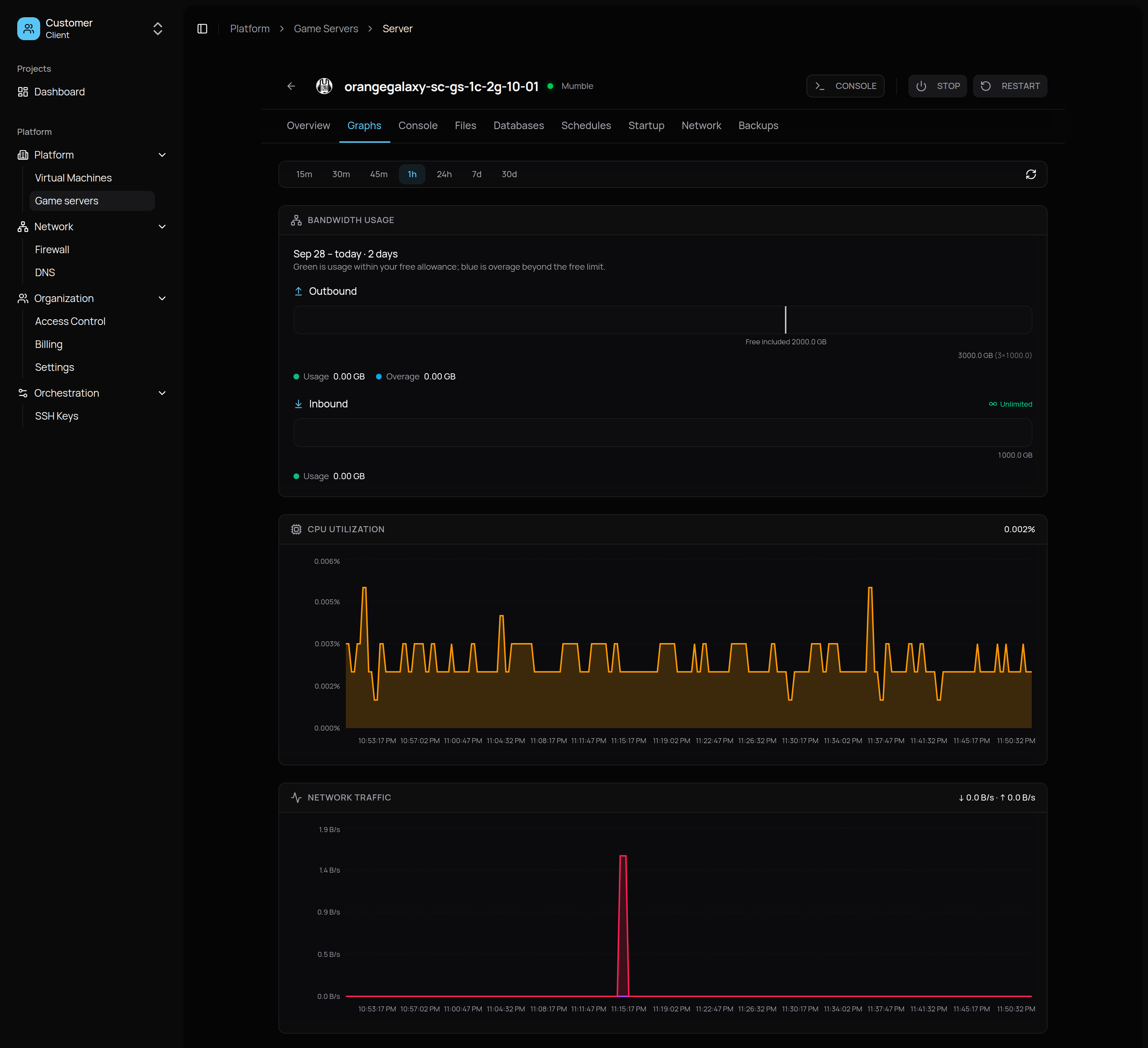
The chart is the one Order the game from the host you want already shows. It is a panel record of an idle voice server. A spark report from the session you stood up for the creator is a different file, and it comes from that server.
What Trustpilot shows for three game hosts
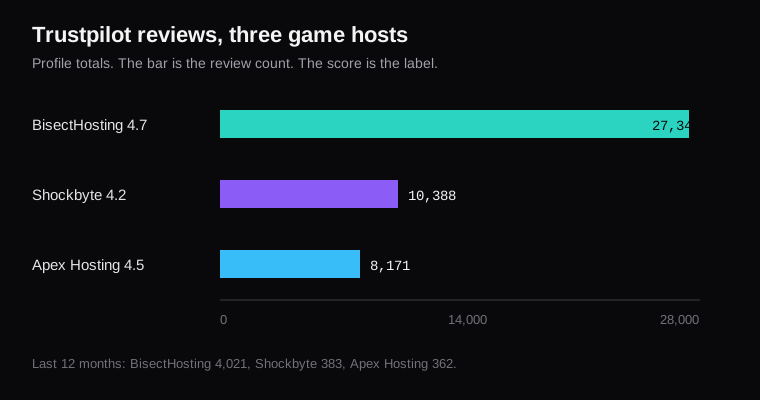
BisectHosting's profile shows 4.7 from 27,344 reviews, 85 percent of them five stars, and 4,021 of them in the last 12 months. Apex Hosting shows 4.5 from 8,171, 88 percent five stars, 362 in the last 12 months. Shockbyte shows 4.2 from 10,388, 77 percent five stars, 383 in the last 12 months. The scores and the counts are what those profile pages display.
The last 12 months are a thin slice of the older file for two of them. Apex's 362 reviews sit inside 8,171. Shockbyte's 383 sit inside 10,388. BisectHosting's recent year is the large one, 4,021 of 27,344. A sponsorship can put a host in front of a creator's viewers in the month you pay for. The profile is the pile those companies already have. A mention and a file of twenty-seven thousand reviews are different jobs. The second one is customers, over years, on a page you can read before you pay anyone.
What a marketplace listing costs beside it
A listing is for a player who is already comparing plans. Community on NodeRings is a $0 subscription, and the commission is 15 percent of the listed price, the arrangement in the billing piece. On a $4 plan that commission is $0.60. The player orders the game from the host they already had in mind. The order page is the plan, the region, and the provider, then the game.
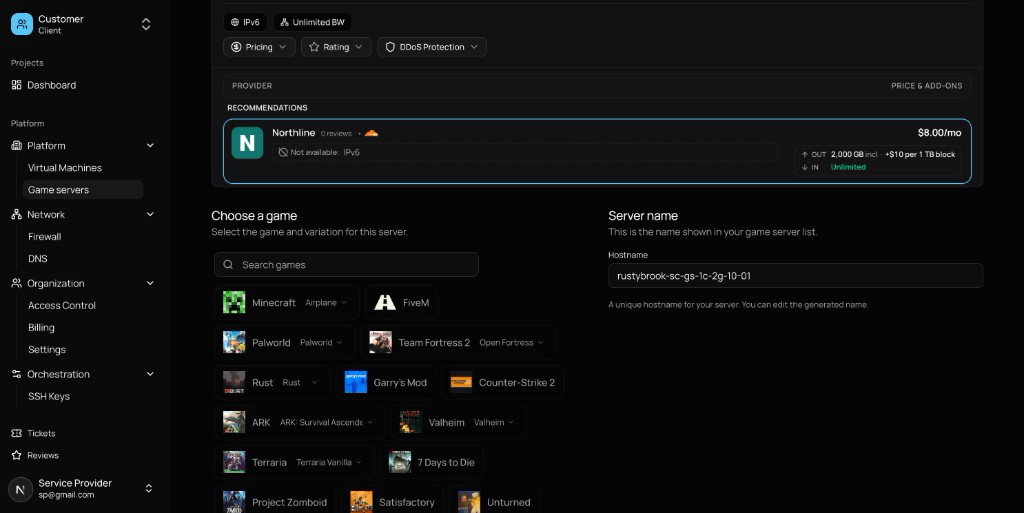
That page is the long tail, written up in Order the game from the host you want. The creator's video is how a viewer who came for the series hears a host's name. The order page is how a player who already has a host in mind finishes the purchase. One of them is a rate card and a disclosure in the video. The other is 15 percent of the sale, and the sale happens on a page that already lists the plan.
Ask those eight lines of three creators, and lay the three prices next to this catalog. A reply around $21 sits in the same band as the typical 30-day community post. A reply of several hundred sits with the $421.77 end of the list, and the extra money needs a job: the seconds on screen, the weeks the description link stays, and the host's name spoken in the video.